I first wrote about the Bullhouse Railway accident back in 2013 and have writen short updates a number of times since. I've now pulled all that research into a single article but rather than publish it here I wrote it as a guest post for the Railway Work, Life & Death project.
Even if you've read all my previous posts about this accident you should find something new in this longer version as I spent quite a bit of time finding more contemperaneous newspaper reports to try and give a more detailed first hand account of the accident and it's immediate aftermath; lots of graphic descriptions of death and mutilation!
Showing posts with label Penistone. Show all posts
Thursday, June 3, 2021
Friday, August 18, 2017
Salvage
It's been quite a while since I last published a local history post (I got distracted by Scottish grouse shooting railways) but a new photo has come to light that shows a different view of one of the local railway accidents I've talked about before; specifically the Bullhouse Railway Accident which occurred on the 16th of July 1884..
All the previous photos I've seen of the accident site have been taken from below the railway line showing the carnage in the road and fields. This photo though is taken from the Penistone side of the bridge looking down into the road. It would appear that rather then showing the direct aftermath of the accident this photo shows the cleanup and possible salvage of useful parts from the destroyed wagons and carriages; note that the upturned carriage is missing it's wheels.
Wednesday, November 9, 2016
The Modeller's Apprentice
It's now been a month since I last posted and over a month since I last did any modelling. This isn't for lack of interest but rather a serious lack of time. This is unlikely to change in the foreseeable future either, so you can expect posts to be slightly more sporadic than usual.
Some of you already know why I've been busy, but many of you won't so here is a clue....
That photo was taken on Sunday when I introduced my three week old son, Toby Arthur, to his first steam train -- I didn't even have to go far as this was another running of the Tin Bath railtour along the line at the bottom of our garden (see here and here for more details)
At the moment any "free" time I might have is probably going to be spent catching up on sleep so it's unlikely I'll get much modelling done for at least a few months. I'm also probably going to be more careful about the use of paints and chemicals in the house so some things may need to wait for me to tidy the garage and for some warmer weather (there is a light covering of snow outside as I type this). That being said I've got a couple of new models I'd like to have a go at designing and some articles to write, both of which I can do on my laptop in short bursts of a few minutes here and there between nappy changes and cuddles.
Of course there is also a flip side to all this, in that as he grows up I'm hoping I'll be able to interest him in trains which would mean days out to preserved railways, train sets (as opposed to model railways), as well as models I could build him. Clearly having called him Toby I'm going to need to build an LNER J70 at some point, and while only a minor character maybe I'll need to find an Ivatt 2MT 2-6-2T as well. Before we get to Thomas the Tank Engine though I'm going to start by reading him Ivor the Engine from a book that was read to me when I was small, plus I've always fancied building a model of Ivor.
Some of you already know why I've been busy, but many of you won't so here is a clue....
That photo was taken on Sunday when I introduced my three week old son, Toby Arthur, to his first steam train -- I didn't even have to go far as this was another running of the Tin Bath railtour along the line at the bottom of our garden (see here and here for more details)
At the moment any "free" time I might have is probably going to be spent catching up on sleep so it's unlikely I'll get much modelling done for at least a few months. I'm also probably going to be more careful about the use of paints and chemicals in the house so some things may need to wait for me to tidy the garage and for some warmer weather (there is a light covering of snow outside as I type this). That being said I've got a couple of new models I'd like to have a go at designing and some articles to write, both of which I can do on my laptop in short bursts of a few minutes here and there between nappy changes and cuddles.
Of course there is also a flip side to all this, in that as he grows up I'm hoping I'll be able to interest him in trains which would mean days out to preserved railways, train sets (as opposed to model railways), as well as models I could build him. Clearly having called him Toby I'm going to need to build an LNER J70 at some point, and while only a minor character maybe I'll need to find an Ivatt 2MT 2-6-2T as well. Before we get to Thomas the Tank Engine though I'm going to start by reading him Ivor the Engine from a book that was read to me when I was small, plus I've always fancied building a model of Ivor.
Monday, November 2, 2015
Down at the Bottom of the Garden
So less than an hour after getting home from ExpoNG yesterday (there will be a post on that later) I was stood at the bottom of the garden camera in hand waiting to watch a train go by. Of course I wasn't interested in the local service train but the second running this year of the Tin Bath. Since February we've done enough work in the garden that I could actually get to the bottom fence and one of the fence posts made an excellent tripod.
Sunday, February 15, 2015
At Long Last
Sunday, October 26, 2014
The Rails Were For...
All the way back in May of 2013, I blogged about the odd set of narrow rails you could see if you visited my local DIY shop. Unfortunately the road has since been resurfaced and the rails can no longer be seen.
The DIY shop is housed in what was, according to old maps, a wagon and wheel works and in the previous post I speculated that, for want of any other information, that the rails might relate to some form of travelling crane. Well I was wrong.
I've now, thanks to issue 190 of the Industrial Railway Record, that the works were the premises of William Gittus & Son Ltd. It appears that in general most of the work involved repairing wagons rather than building new ones, but they had a very distinctive builders plate featuring a dog which they attached to the wagons they worked on.
While it is nice to be able to put a name to the company that ran the works, the article also clears up the issue of the rails...
The DIY shop is housed in what was, according to old maps, a wagon and wheel works and in the previous post I speculated that, for want of any other information, that the rails might relate to some form of travelling crane. Well I was wrong.
I've now, thanks to issue 190 of the Industrial Railway Record, that the works were the premises of William Gittus & Son Ltd. It appears that in general most of the work involved repairing wagons rather than building new ones, but they had a very distinctive builders plate featuring a dog which they attached to the wagons they worked on.
While it is nice to be able to put a name to the company that ran the works, the article also clears up the issue of the rails...
by 1905 several developments had taken place ... a large wooden building (which could accommodate six wagons and was known to the workmen as the "big shed") was constructed on the west side of the dike. The big shed had a full length traverser at it's west end and was served by four sidings. ... Further expansion took place in the 1920s when extensions were made to the Big Shed and a second similar sized building was erected on its west side. The traverser was then situated between the two shops and two horses were employed to shunt in this area.So we now have a definitive answer, the rails were the remains of the wagon traverser.
Tuesday, November 19, 2013
EM1
When it comes to railways I'm definitely a steam person. In fact I've yet to find a diesel or electric locomotive that inspires me in any fashion. Having said that I am, however, also interested in the history of the line that runs along the bottom of the garden and so I'll make an exception for the EM1. The EM1, which stands for Electric Mixed-Traffic 1, was specifically designed and built for the Woodhead line. They were powered from 1.5 kV DC overhead catenary and employed regenerative breaking to actually feed power back into the system when running downhill. They were predominately used for working freight trains through Penistone as this photo from 1955 shows.
The photo shows number 26020 which coincidentally is the only preserved member of the class and which I photographed at the National Railway Museum when I visited for The Great Gathering.
If you want more details on the EM1 then Wikipedia has a fairly informative page, and if you fancy one in model form then Heljan produce an OO gauge model exclusively for Olivia's Trains.
The photo shows number 26020 which coincidentally is the only preserved member of the class and which I photographed at the National Railway Museum when I visited for The Great Gathering.
If you want more details on the EM1 then Wikipedia has a fairly informative page, and if you fancy one in model form then Heljan produce an OO gauge model exclusively for Olivia's Trains.
Thursday, November 14, 2013
Cool Runnings
This post focuses on another, of the many, railway accidents to have occurred in and around Penistone (see here and here for previous posts on this topic).
At 7:53am on the 1st of January 1885, eight minutes after the scheduled departure time, a special excursion train to Liverpool and Southport left Sheffield. The train should have reached Penistone at 8:20am but at 8:26am it was travelling at around 20 miles an hour as it passed Barnsley Junction signal box approximately half a mile south of Penistone station (see the 1894 map to the right).
At approximately 8:21am a goods train, of mostly empty wagons, left Penistone goods yard heading south through Penistone station. After passing Huddersfield Junction signal box, with the steam off, the train was travelling at around 12 miles an hour as it headed towards Barnsley Junction.
By 8:27am two people were dead, two fatally injured, and a further 47 had suffered minor injuries.
The full details of what happened between 8:26am and 8:27am on the morning of the 1st of January 1885 come from the official accident report compiled by Major F. A. Marindin, who had also been responsible for the report into the accident at Bullhouse Bridge the previous July. Unlike that accident I haven't been able to find any other contemporary reports or photographs, but the official report runs to ten full pages and is packed with eye witness and expert testimony.
Before we can fully understand the accident report we need to understand the makeup of each train as specific carriages and wagons are referred to throughout the eye witness evidence. Firstly we have the passenger train that was heading from Sheffield to Liverpool and Southport. It was being operated, as was the goods train, by the Manchester, Sheffield and Lincolnshire Railway (MS&LR) company and consisted of an engine and 18 carriages (note that I'm using break instead of brake as this is the spelling used in the original report):
The reason for two head guards being present is that each was in charge of a separate portion of the train. William Spinks was in overall charge as well as being head guard for the nine rear coaches which were destined for Southport, while the front nine coaches, which were destined for Liverpool, were under the oversight of Joseph Plowright.
There are slightly less details about the makeup of the goods train and I don't have running numbers for all 26 wagons. The details I have managed to deduce from the report are as follows:
As you can see both trains were recorded as being pulled by 0-6-0 tender engines (number 229 and 464 respectively) and while I don't know for certain, I'm assuming that they were both of the same design, what would later be referred to as GCR Class 18, as this appears to have been the only class of 0-6-0 tender engines in use by the MS&LR at the time of the accident (if anyone knows differently please do let me know).
From the report it would appear that Robert Higgs, the guard on the goods train, was the only one to fully see the accident unfold. He had this to say in his evidence to the commission:
While the investigation had to look into how the accident unfolded, the more important questions they had to answer were what caused the accident and could it have been prevented. The focus of the investigation seems to have quickly settled on the axle of Shireoaks No. 218 which was found in two parts after the accident (as described by John Thorpe above).
Shireoaks No. 218, as it's name suggests, was a private owner waggon belonging to Shireoaks Colliery. The report doesn't describe the wagon in any detail, but I'm assuming it would be similar to the Shireoaks waggon captured in this photo while at Penistone steelworks.
Rather than being owned by the railway companies, private owner wagons were built by or for private owners. Often collieries who would need to ship their coal across the country, but often by local merchants or companies. There were no specific guidelines agreed between the builders of these waggons and the railway companies as to their size or the materials used to build them. The railway companies were responsible though for checking the waggons periodically to ensure they were safe to use on the railway. In this instance it would appear that there had been no cause for concern over Shireoaks No. 218 in the days leading up to the accident, and there was no suggestion that the wagon was unusual in design. A chemical analysis of the broken axle did, however, highlight the probably cause of the accident.
The chemical analysis of the iron from the broken axle (shown in the table to the right) showed a higher than normal percentage of phosphorus. While 0.263% may not seem like very much, when considered in conjunction with the cold weather on the day of the accident (William Genders, the permanent-way inspector, stated that it was a "frosty morning and the ground was hard") it is likely to have been the cause of the axle failing.
The problem with phosphorus in wrought iron is, apparently (I'm not a metallurgist), that concentrations over 0.2% make the iron cold short or, in layman’s terms, brittle at cold temperatures. The iron in the axle, at 0.263% phosphorous, was clearly not suitable for use as a wagon axle and certainly not on a frosty morning. The failure was, therefore, an accident waiting to happen, although no one could have predicted that the axle would fail just as two trains were about to pass each other. Had the passenger train been on time it is likely that while the axle would still have given way, only the waggon itself would have been damaged.
In the conclusion to his report, F. A. Marindin, noted that:
At 7:53am on the 1st of January 1885, eight minutes after the scheduled departure time, a special excursion train to Liverpool and Southport left Sheffield. The train should have reached Penistone at 8:20am but at 8:26am it was travelling at around 20 miles an hour as it passed Barnsley Junction signal box approximately half a mile south of Penistone station (see the 1894 map to the right).
At approximately 8:21am a goods train, of mostly empty wagons, left Penistone goods yard heading south through Penistone station. After passing Huddersfield Junction signal box, with the steam off, the train was travelling at around 12 miles an hour as it headed towards Barnsley Junction.
By 8:27am two people were dead, two fatally injured, and a further 47 had suffered minor injuries.
The full details of what happened between 8:26am and 8:27am on the morning of the 1st of January 1885 come from the official accident report compiled by Major F. A. Marindin, who had also been responsible for the report into the accident at Bullhouse Bridge the previous July. Unlike that accident I haven't been able to find any other contemporary reports or photographs, but the official report runs to ten full pages and is packed with eye witness and expert testimony.
Before we can fully understand the accident report we need to understand the makeup of each train as specific carriages and wagons are referred to throughout the eye witness evidence. Firstly we have the passenger train that was heading from Sheffield to Liverpool and Southport. It was being operated, as was the goods train, by the Manchester, Sheffield and Lincolnshire Railway (MS&LR) company and consisted of an engine and 18 carriages (note that I'm using break instead of brake as this is the spelling used in the original report):
- 0-6-0 tender engine #229 (John Coldwell driver, John Healey fireman)
- third class break #407 (under-guard Jacob Hanby)
- third-class #452
- third-class #417
- third-class #255
- composite #96
- third-class #470
- third-class #466
- third-class #109
- third class break #463 (head guard Joseph Plowright)
- third class break #499
- third-class #331
- composite #98
- third-class #657
- third-class #188
- composite #102
- third-class #230
- third-class #400
- third class break #516 (head guard William Spinks)
The reason for two head guards being present is that each was in charge of a separate portion of the train. William Spinks was in overall charge as well as being head guard for the nine rear coaches which were destined for Southport, while the front nine coaches, which were destined for Liverpool, were under the oversight of Joseph Plowright.
There are slightly less details about the makeup of the goods train and I don't have running numbers for all 26 wagons. The details I have managed to deduce from the report are as follows:
- 0-6-0 tender engine #464 (John Schofield driver, Edmund Peacock fireman)
- MS&LR goods wagon #582 (the only loaded wagon, which was picked up at Penistone)
- five empty Shireoaks waggons (numbers 98, 575, 1, 218, and 219 all picked up at Hadfield)
- five empty Kiveton Park Colliery wagons (numbers 504, 413, 227, and 543 all picked up at Ardwick)
- two empty wagons for Whaleswood belonging to A. Lawton (picked up at Ardwick)
- four empty Shireoaks wagons (picked up at Old Dinting)
- nine empty Shireoaks wagons (picked up at Ardwick)
- break-van (guard Robert Higgs)
As you can see both trains were recorded as being pulled by 0-6-0 tender engines (number 229 and 464 respectively) and while I don't know for certain, I'm assuming that they were both of the same design, what would later be referred to as GCR Class 18, as this appears to have been the only class of 0-6-0 tender engines in use by the MS&LR at the time of the accident (if anyone knows differently please do let me know).
From the report it would appear that Robert Higgs, the guard on the goods train, was the only one to fully see the accident unfold. He had this to say in his evidence to the commission:
I was looking out ahead on the left-hand side, and I saw fire flying from a waggon, I think the fifth from the engine. I then saw the waggon oscillating very much. I then noticed it taking to the 6-foot way, and the wagon behind it followed. I then saw a waggon mount up. At that time time the engine of my train and the engine of the passenger would be about passing each other. I then saw the passenger engine strike one of the waggons, rearing it up on end, back towards my train. The waggon then fell back into the passenger train. I had put my break on as soon as I saw the fire flying. At that time I had not noticed the passenger train. It all happened quicker than it would take to tell.The driver of the passenger train, John Coldwell, gives a similar account in his evidence:
When I first saw the mineral train the engine was over 100 yards away, and at that time I saw nothing wrong with it. When the engine was about 20 yards from me I saw a waggon (which I thought was the fifth waggon) was running on the 6-foot. I cannot say that I saw this waggon actually leave the rails. ... I shut off steam at once and applied the vacuum-break, and my fireman at the same time applied the tender-break. Both breaks were hard on before my engine struck the waggon which was in the 6-foot, and I think that before the collision took place the speed of my train had been reduced to nearly half the speed at which we had been travelling. ... Just before the collision I saw the waggon which had been running in the 6-foot work into the 4-foot of the down line. I struck it with the front of my engine, so that the smoke-box door was driven in. As my engine struck it I bent down on the foot-plate, as I thought the waggon might come over the engine, so that I cannot describe what followed.Head guard, William Spinks, who was travelling in the rear van of the passenger train, continues the story:
Immediately I felt the vacuum-break go on I applied my hand-break. I looked out of the right side of my van. The engine of the mineral train had then passed me. I saw some of the waggons of the train in collision with my train, and one waggon struck the side of my van. I saw it coming and bobbed my head in just as it knocked the side lamp off. We were pulling up very quickly, and had just about stopped when the side lamp was knocked off my van.It should be clear, from this evidence, that the accident happened extremely quickly and that there was nothing the drivers of either train could have done to avoid it. The best description of the aftermath is provided by John Thorpe, the assistant locomotive superintendent in charge at Sheffield, who arrived on scene at around 9.45am:
I first saw the mineral engine standing with two waggons attached, on the up line about 40 yards east of the last break-van of the passenger train. I then ... walked the length of the passenger train to see that all the passengers had been got out, and found that they had. I noticed that all the carriages were on their wheels. I walked round the train and back to the rear of it, and found two coals waggons on their sides, and Shireoaks waggon No. 1 reared up. It was then standing nearly opposite to the rear van of the passenger train, and was nearly cut in half. ... next was Shireoaks waggon 218 on its side, with the opening to the off side, lying on the the 6-foot, damaged, and one pair of wheels out; ... next was Shireoaks No. 219, partly on its side, and rather over towards the 6-foot way; next was Kiveton Park No. 504, on its wheels but off the rails, partly in the 4-foot way and partly in the 6-foot way; next was Kiveton Park No. 413, off the rails, but not much damaged; next Kiveton Park No. 227, off the rails slightly, and not damaged to any extent, next was Kiveton Park No. 543, with one pair of wheels off. ... Under Kiveton Park No. 543 there was lying a wheel and short length of axle, which I afterwards found to belong to Shireoaks waggon No. 218; the other wheel and part of axle was lying further to the west on the bridge, in the 6-foot way; opposite to the point of collision. ... The passenger train had no couplings broken, and none of the vehicles had telescoped. The damage had been done by the waggon (probably No. 1) dragging along the side of the passenger train. ... The waggon which took the shock of the collision, and then fell back on the passenger train, was clearly No. 1 Shireoaks, which was the fourth from the engine, and I believe that No. 218 Shireoaks, which was the fifth waggon, and the first to leave the rails, must have got buffer-locked with this waggon, and then pushed it out diagonally across the 6-foot, immediately in front of the passenger engine.An appendix to the report goes into more details as to the damage to the passenger train, and while most carriages showed some damage (mostly scratched panelling and broken windows) the final three carriages of the front portion of the train (numbers 109, 466, and 470) had suffered so much damage that they would need to be completely rebuilt before they could be used again.
While the investigation had to look into how the accident unfolded, the more important questions they had to answer were what caused the accident and could it have been prevented. The focus of the investigation seems to have quickly settled on the axle of Shireoaks No. 218 which was found in two parts after the accident (as described by John Thorpe above).
Shireoaks No. 218, as it's name suggests, was a private owner waggon belonging to Shireoaks Colliery. The report doesn't describe the wagon in any detail, but I'm assuming it would be similar to the Shireoaks waggon captured in this photo while at Penistone steelworks.
Rather than being owned by the railway companies, private owner wagons were built by or for private owners. Often collieries who would need to ship their coal across the country, but often by local merchants or companies. There were no specific guidelines agreed between the builders of these waggons and the railway companies as to their size or the materials used to build them. The railway companies were responsible though for checking the waggons periodically to ensure they were safe to use on the railway. In this instance it would appear that there had been no cause for concern over Shireoaks No. 218 in the days leading up to the accident, and there was no suggestion that the wagon was unusual in design. A chemical analysis of the broken axle did, however, highlight the probably cause of the accident.
| Graphitie carbon | Trace |
| Combined do. | 0.078 |
| Silicon | 0.229 |
| Phosphorus | 0.263 |
| Sulphur | None |
| Manganese | 0.360 |
| Iron | 99.070 |
The problem with phosphorus in wrought iron is, apparently (I'm not a metallurgist), that concentrations over 0.2% make the iron cold short or, in layman’s terms, brittle at cold temperatures. The iron in the axle, at 0.263% phosphorous, was clearly not suitable for use as a wagon axle and certainly not on a frosty morning. The failure was, therefore, an accident waiting to happen, although no one could have predicted that the axle would fail just as two trains were about to pass each other. Had the passenger train been on time it is likely that while the axle would still have given way, only the waggon itself would have been damaged.
In the conclusion to his report, F. A. Marindin, noted that:
... it nevertheless appears from the evidence that the existing regulations as to the construction of traders' waggons and inspection of waggon stock generally are far from satisfactory. ... it is clear that there is really no absolute hold over the builders, especially as to the class of materials which they make use of; besides which, the constant interchange of waggons from one Company's line to another's makes it almost impossible for any Company to guard against a wagon unfit for running coming upon its line.His proposed solution to the problem was to suggest that:
... it is highly desirable that all waggons commencing to run upon any line should either be the property of the Railway Company, or should be carefully inspected before being permitted to enter upon the line, that care should be taken that all materials of which they are constructed are of good quality, and that there should be a systematic periodical inspection of the waggon stock of every description, including a rigid examination of all axles after they have run for a specified time. All waggons to bear a label to show that they have been passed for running by some Railway Company, and to be legibly marked with the date when they were last thoroughly overhauled.All of which sounds eminently sensible to me.
- Railway accidents. Returns of accidents and casualties as reported to the Board of Trade by the several railway companies in the United Kingdom, during the three months ending 31st March 1885, in pursuance of the Regulation of Railways Act (1871), 34 & 35 Vict, cap. 78; together with reports of the inspecting officers of the Railway Department to the Board of Trade upon certain accidents which were inquired into.
Saturday, September 21, 2013
Penistone Is...
As I mentioned in the previous post many of the presents I received for my recent birthday were railway related, many of them were also books. One of those books was a modern reproduction of the 1863 copy of Bradshaw's Handbook. This is the same version as Michael Portillo uses in his Great British Railway Journeys TV Series -- strangely this isn't a programme I've ever actually watched.
George Bradshaw is best know for publishing railway timetables, but he also published a number of guides to the places the railway lines passed through. While there were a number of versions of these guides, as I mentioned above, this particular book collects together the four volumes and reflects the railway as it was in 1863. Given that both the Manchester, Sheffield and Lincolnshire Railway and the Yorkshire and Lancachire Railway had both reached Penistone by 1863, the first thing I looked for was an entry for Penistone.
I eventually found Penistone on page 52 of part 4 and it would appear that Bradshaw (or more likely someone working for his company, as he died in 1853) didn't really think much of the area as the full entry reads:
We'll have to see what Michael Portillo thinks of Penistone when series 5 of Great British Railway Journeys airs on TV. Although the list of journeys hasn't yet been announced my next door neighbour saw him with a TV crew a few stations up the line earlier in the summer.
George Bradshaw is best know for publishing railway timetables, but he also published a number of guides to the places the railway lines passed through. While there were a number of versions of these guides, as I mentioned above, this particular book collects together the four volumes and reflects the railway as it was in 1863. Given that both the Manchester, Sheffield and Lincolnshire Railway and the Yorkshire and Lancachire Railway had both reached Penistone by 1863, the first thing I looked for was an entry for Penistone.
I eventually found Penistone on page 52 of part 4 and it would appear that Bradshaw (or more likely someone working for his company, as he died in 1853) didn't really think much of the area as the full entry reads:
This is a small market town, situated on the banks of the Don, in the midst of a wild and dreary district. It contains several large cotton and woollen factories, and a free Grammar School.Today Penistone is a still an active market town set in wonderful countryside that I challenge anyone to call dreary, even when the weather is miserable!
We'll have to see what Michael Portillo thinks of Penistone when series 5 of Great British Railway Journeys airs on TV. Although the list of journeys hasn't yet been announced my next door neighbour saw him with a TV crew a few stations up the line earlier in the summer.
Labels:
books,
history,
Penistone,
Standard Gauge
Wednesday, June 5, 2013
The Disused Pit Of Gloom
I'm doing a lot of teaching this week, so there will be little time for any real modelling until the weekend. Fortunately I have another history post to keep you all entertained.
While looking into the history of the railway in Penistone I've seen a number of brief references to there having been a turntable not far from the station, but it wasn't entirely clear where it had been positioned. During my research into the apocryphal cow I spent some time looking at old maps, at which point the location of the turntable, just south of the station, was easy to to spot (this specific map dates from 1931).
By 1965 the turntable had disappeared from the maps and I so I assumed it had been filled in or built over, especially as I'd never seen any sign of it while walking to and from the station. It isn't always easy to relate old maps to the current terrain, especially given how much the area around Penistone station has changed since the maps were drawn, so imagine my surprise last winter when I almost fell into the turntable pit.
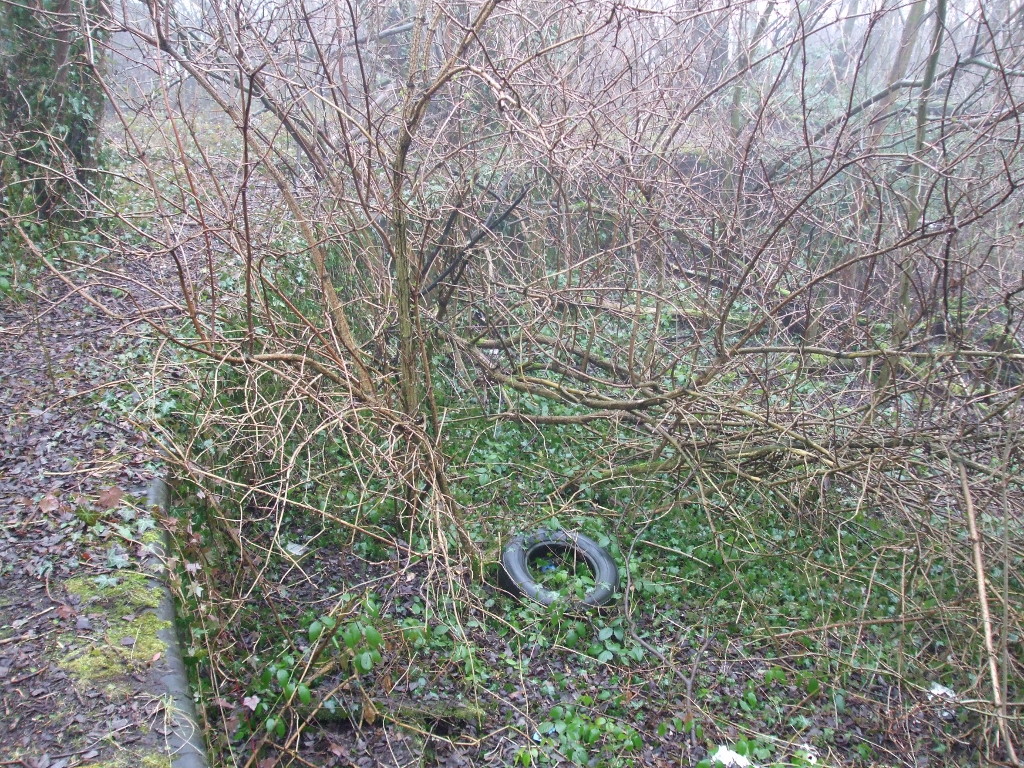
There are actually two footpaths along the railway linking our house with the station. Originally there was just a path right alongside the line, but a couple of years ago a second path was added a little further from the line side to give better pedestrian access to a new housing estate. During the summer this new path is full of interesting wildlife and plants, including a fantastic display of lupins and some interesting caterpillars. During the winter it isn't quite so interesting but it is slightly shorter, so on one icy day I followed the path hoping I'd reach the station without falling over. A combination of the snow highlighting things differently and the lack of undergrowth meant that suddenly there was the turntable pit. Unfortunately I didn't have a camera on me so I had to go back a few days later for some photos.
Given the number of trees growing within and around the pit it's impossible to get a good photo showing its full extent, but from the left hand photo you should be able to get a fairly good idea of its size. I'd hoped to explore the pit a little more during the summer when it wasn't quite so wet and boggy looking, but of course as soon as spring arrived more shrubs grew up making it less accessible. When winter comes around again I'll try and take a better look.
While looking into the history of the railway in Penistone I've seen a number of brief references to there having been a turntable not far from the station, but it wasn't entirely clear where it had been positioned. During my research into the apocryphal cow I spent some time looking at old maps, at which point the location of the turntable, just south of the station, was easy to to spot (this specific map dates from 1931).
By 1965 the turntable had disappeared from the maps and I so I assumed it had been filled in or built over, especially as I'd never seen any sign of it while walking to and from the station. It isn't always easy to relate old maps to the current terrain, especially given how much the area around Penistone station has changed since the maps were drawn, so imagine my surprise last winter when I almost fell into the turntable pit.
There are actually two footpaths along the railway linking our house with the station. Originally there was just a path right alongside the line, but a couple of years ago a second path was added a little further from the line side to give better pedestrian access to a new housing estate. During the summer this new path is full of interesting wildlife and plants, including a fantastic display of lupins and some interesting caterpillars. During the winter it isn't quite so interesting but it is slightly shorter, so on one icy day I followed the path hoping I'd reach the station without falling over. A combination of the snow highlighting things differently and the lack of undergrowth meant that suddenly there was the turntable pit. Unfortunately I didn't have a camera on me so I had to go back a few days later for some photos.
Given the number of trees growing within and around the pit it's impossible to get a good photo showing its full extent, but from the left hand photo you should be able to get a fairly good idea of its size. I'd hoped to explore the pit a little more during the summer when it wasn't quite so wet and boggy looking, but of course as soon as spring arrived more shrubs grew up making it less accessible. When winter comes around again I'll try and take a better look.
Monday, May 27, 2013
Penistone Wagon and Wheel Works
As I've mentioned before I've made a couple of trips to the local DIY store recently to buy materials to construct the baseboard and back scene. The shop is housed in a small corner of an old works, and while many of the buildings have changed over the years and the access road has been tarmaced/concreted over there are still signs of its past, including what look like narrow gauge rail tracks (they are next to the cars in the first photo).
From an intial inspection they appear to simply start and stop at the ends of the passage shown in the photo, and so I don't think they are part of a railway as such. A quick look at some old maps though showed that the works was originally built as a wagon and wheel works.
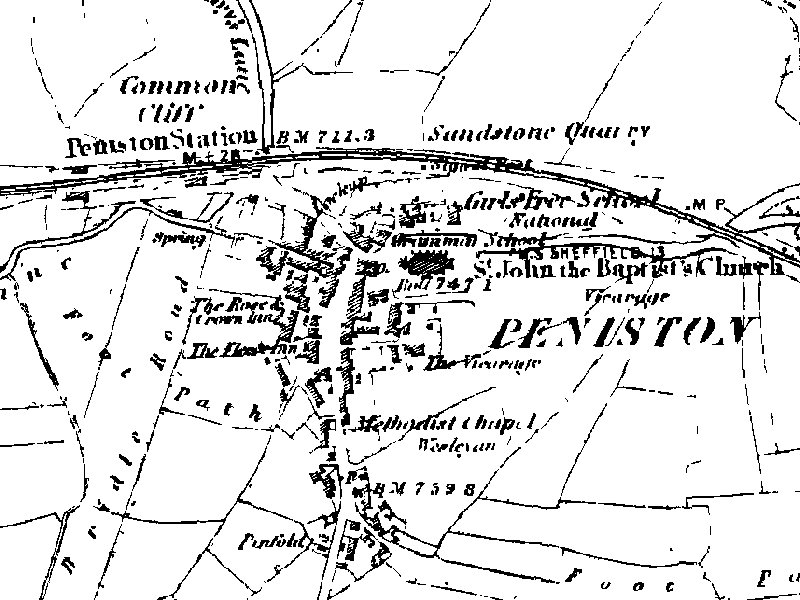
The works first appears on a 1905 map showing just a single building accessed by five short tracks. Interestingly they are crossed at right angles by two lines, which don't seem to represent a road or anything. By 1931, when the second map was published, more buildings had been constructed and more track laid into the works but the same parallel lines are visible and it is now clear that they are in the same position as the rails left over today. By 1971, when the third map was published, the works was no longer associated with the railway and the tracks had been removed, but the two parallel lines remain.
Unfortunately I can't find any useful old photos of the works. In fact the only photo I've managed to find is this small corner section of an aerial photo taken on the 14th of July 1926. The photographer was actually focusing on the steel works, but you can at least see that there were a lot of wagons lined up by the works buildings.
Without any other information, I'm tempted to suggest that the rails might have been for some form of travelling crane which could have been moved to access any of the tracks passing through the works. If anyone has any other information or photos of the works please do leave a comment.
I find it interesting that Penistone used to have a wagon works and now most of the items I have for sale through Penistone Railway Works are wagons of one form or another. Coincidence?
From an intial inspection they appear to simply start and stop at the ends of the passage shown in the photo, and so I don't think they are part of a railway as such. A quick look at some old maps though showed that the works was originally built as a wagon and wheel works.
The works first appears on a 1905 map showing just a single building accessed by five short tracks. Interestingly they are crossed at right angles by two lines, which don't seem to represent a road or anything. By 1931, when the second map was published, more buildings had been constructed and more track laid into the works but the same parallel lines are visible and it is now clear that they are in the same position as the rails left over today. By 1971, when the third map was published, the works was no longer associated with the railway and the tracks had been removed, but the two parallel lines remain.
Unfortunately I can't find any useful old photos of the works. In fact the only photo I've managed to find is this small corner section of an aerial photo taken on the 14th of July 1926. The photographer was actually focusing on the steel works, but you can at least see that there were a lot of wagons lined up by the works buildings.Without any other information, I'm tempted to suggest that the rails might have been for some form of travelling crane which could have been moved to access any of the tracks passing through the works. If anyone has any other information or photos of the works please do leave a comment.
I find it interesting that Penistone used to have a wagon works and now most of the items I have for sale through Penistone Railway Works are wagons of one form or another. Coincidence?
Sunday, April 7, 2013
Remarkable Occurrences
Having recently been caught out by the title of a book I wasn't holding out too much hope for another local history book I picked up via eBay; Remarkable Occurrences and Interesting Dates by John Wood published by Penistone Post Office. My luck appears to have turned, however, as not only is the book definitely about Penistone (and the surrounding area) it has a whole section dedicated to railway accidents.From the preface I can tell you that this book is actually a collection of five previously published pamphlets written by John Wood who died on the 4th of July 1888. The book itself was posthumously published in 1890 to meet demand for a compact collected version of the pamphlets. Given these dates it's fair to say that information about the early railway accidents that occurred in and around Penistone is likely to be from first hand accounts, and hence more reliable than the relevant Wikipedia articles.
The first railway incident described in the book is the Bullhouse Bridge Accident which I've already discussed in some detail. Interestingly the author comes to the same conclusion about the newsworthiness of the accident as I did in that only four previous accidents had seen such a high death toll. While some extra details of the coroners inquest are given there isn't anything new in the description to add to my existing article on this accident, and I'll save the rest of the book for future posts when I've researched the other accidents it covers more thoroughly.
Tuesday, March 19, 2013
The Asthmatic Express
Since we bought our house almost four years ago we have had a steam train pass across the bottom of the garden on two separate occasions (see here and here for the details), yet all we have managed to see was smoke and steam. Well Sunday turned out to be mostly third time lucky.
The first problem was that I didn't know that any steam trains were due to pass the house. While I check the UK Steam Tours web page fairly regularly, I'd either not checked it recently enough or had simply missed the entry (it probably didn't help that I'm use to the service running in the autumn). So just as on the first occasion the first we knew about it was the distinctive sound echoing up the valley as the train headed for Penistone. Fortunately a number of the neighbours have trimmed back some of the trees in their gardens since last time, and with the remaining trees not yet having leaves we managed to see more than just smoke. Unfortunately I didn't have the camera to hand, but we saw enough to know that, as on previous occasions, the train was being pulled by a pair of LMS Black 5 locomotives.
Having missed out on a picture for a third time, I made the rather rash descision to grab the camera and run the half mile or so across Penistone to get a shot of them passing over the viaduct. I was fairly certain I had about four minutes as the train would have to wait at the station to allow the normal scheduled service to pass through. Unfortunately, even when I was reasonably fit, I was never a sprinter, but I did run as fast as my legs would carry me, and I did just make it. Given the quality of the pictures I managed to take (this one was the best of the bunch) I'm not entirely sure the exercise was worth it, especially as I'm still coughing and wheezing over 24 hours later (I did have asthma as a child, but other than during a trip to Beijing it hasn't really bothered me in years).
While I was having problems drawing in enough air to breathe comfortably, the engines were certainly having no such difficulties as the drivers pulled sharply away from Penistone and over the viaduct towards Huddersfield. Hopefully next time I'll manage a photo of them at the bottom of the garden!
The first problem was that I didn't know that any steam trains were due to pass the house. While I check the UK Steam Tours web page fairly regularly, I'd either not checked it recently enough or had simply missed the entry (it probably didn't help that I'm use to the service running in the autumn). So just as on the first occasion the first we knew about it was the distinctive sound echoing up the valley as the train headed for Penistone. Fortunately a number of the neighbours have trimmed back some of the trees in their gardens since last time, and with the remaining trees not yet having leaves we managed to see more than just smoke. Unfortunately I didn't have the camera to hand, but we saw enough to know that, as on previous occasions, the train was being pulled by a pair of LMS Black 5 locomotives.
Having missed out on a picture for a third time, I made the rather rash descision to grab the camera and run the half mile or so across Penistone to get a shot of them passing over the viaduct. I was fairly certain I had about four minutes as the train would have to wait at the station to allow the normal scheduled service to pass through. Unfortunately, even when I was reasonably fit, I was never a sprinter, but I did run as fast as my legs would carry me, and I did just make it. Given the quality of the pictures I managed to take (this one was the best of the bunch) I'm not entirely sure the exercise was worth it, especially as I'm still coughing and wheezing over 24 hours later (I did have asthma as a child, but other than during a trip to Beijing it hasn't really bothered me in years).
While I was having problems drawing in enough air to breathe comfortably, the engines were certainly having no such difficulties as the drivers pulled sharply away from Penistone and over the viaduct towards Huddersfield. Hopefully next time I'll manage a photo of them at the bottom of the garden!
Saturday, February 23, 2013
The Bullhouse Railway Accident
As you may remember the first accident to befall the railway around Penistone involved a cow, and while the accident was undoubtedly bad for the cow no one else was killed. Unfortunately many of the people involved in the first major accident weren't so lucky.
On the 16th of July 1884 the 12:30pm express train from Manchester London Road to London King's Cross, operated by the Manchester, Sheffield and Lincolnshire Railway and driven by the experienced Sam Cawood (at this point he had been driving main line passenger trains for 12 years) had passed through the Woodhead tunnel and at 1:21pm was was running downhill towards Penistone passing the signal box at Bullhouse Colliery when, without warning, the locomotives crank axle snapped. The driver immediately applied the brakes bringing the locomotive to a stand 517 yards further down the line, unfortunately the driving wheels, now no longer held in place by the axle, had spread outwards causing the track to distort.
The train that day consisted of MS&LR locomotive number 443, coupled to a Cheshire Lines Committee (CLC) horsebox, a Great Northern brake van, three Great Northern composite carriages, another Great Northern brake van, an MS&LR third-class brake carriage, two MS&LR composite carriages, an MS&LR third-class carriage, and finally an MS&LR brake van. The coupling between the locomotive and the horsebox held, but the coupling between the horsebox and the rest of the train failed and as the vehicles derailed on the distorted track they ran down an embankment before breaking up in the fields and road below the railway.
Just as with the previous accident a lot of this information comes courtesy of an article in The Illustrated London News published ten days after the accident:
Their main illustration was, however, this fantastic panoramic view of the accident site:
It wasn't just The Illustrated London News who thought the accident worthy of an illustration, as The Graphic, published on the same day, also included illustrations of the accident site.
Personally I prefer the panoramic view from The Illustrated London News; The Graphic's illustration reminds me more of the style of drawing you would find in a modern graphic novel. Regardless of style both images seem to agree in most of the details, right down to the number of air vents on the top of the carriages! Given that the images do agree to such a large extent, I'm assuming that they were both drawn from photos taken before the carriages were removed from the road; these two being prime candidates.
We are quite lucky in Penistone, in that there are actually quite a lot of old photos of the town, surrounding countryside, and memorable events that are quite easy to come by. Most of these photos were taken by Joshua Biltcliffe and sold as postcards from his shop in the centre of Penistone. Now I don't know for certain that either of these photos are by Joshua Biltcliffe but given the style of the postcard backing that would be my assumption, at least for the left hand photo; the right hand image came from the Railways Archive, but if anyone comes across an actual copy of the postcard please let me know. Regardless of who the photographer was we can see that the newspaper illustrations really are quite accurate.
On the 27th of July, just a day after the newspaper articles appeared, the official report into the accident was presented to the Board of Trade. The report, assembled by Major F. A. Marindin, runs to twenty pages and provides a huge amount of extra detail.
The first thing to note from the report is that the death toll had risen to 24 with J. W. Poole having died on the 30th of July and Miss Totlow on the 6th of August -- these dates are after the report was written and so I assume were added before it was collated into the accident return book which deals with all accidents in the nine months ending on the 30th of September 1884.
Locomotive number 443 was a 4-4-0 designed by Charles Sacré (referred to now as a Class D12 locomotive). Unfortunately I can't find a useable photo of number 443, but I've included a photo of number 440 which is of the same class; also note how this photo compares well with the locomotives depicted in another of The Illustrated London News' drawings. At the time of the accident the crank axle, which had been fitted in May 1883 and been checked thoroughly at overhaul in October of 1883, had successfully completed 50,776 miles without incident. The report seems to have been very thorough, including testing of the composition of the metal crank axle and expert testimony which suggests that the breaking of the crank axle alone wouldn't normally have resulted in such a large accident; 247 crank axles had broken during 1883 without any serious accidents occurring. In this incident the major problem was the broken coupling in combination with the curve the train was negotiating. Once the carriages became disconnected from the locomotive and left the damaged rails they naturally moved in a more or less straight line, down the embankment, rather than following the curve of the railway.
The reports main criticism was, however, reserved for the braking system in use on the train. The problem was that Sacré had fitted the D12 locomotives with a simple Smith vacuum brake. In a Smith vacuum brake, an ejector on the locomotive creates a vacuum in a continuous pipe along the train, allowing the external air pressure to operate brake cylinders on each vehicle. This is a cheap system to build and maintain, but has a major weakness; if the locomotive becomes detached from the rest of the train, or if the vacuum pipe is ruptured in anyway, then the brakes stop working. In the conclusion to his report Major Marindin summarises this aspect of the disaster as follows (note that the report uses break instead of brake throughout as was apparently customary):
While the early years of the railways saw many accidents, few resulted in such a large loss of life. In fact, only four previous accidents (assuming I can trust this Wikipedia page) had resulted in more deaths:
If you consider the random nature of the accident along with the exposure it was given in the newspapers you can maybe imagine why, three years later, it was used as a way of introducing the randomness of death into a religious tract, with the title Suddenly! An Incident of the Penistone Railway Accident being a good way of attracting a readers attention.
On the 16th of July 1884 the 12:30pm express train from Manchester London Road to London King's Cross, operated by the Manchester, Sheffield and Lincolnshire Railway and driven by the experienced Sam Cawood (at this point he had been driving main line passenger trains for 12 years) had passed through the Woodhead tunnel and at 1:21pm was was running downhill towards Penistone passing the signal box at Bullhouse Colliery when, without warning, the locomotives crank axle snapped. The driver immediately applied the brakes bringing the locomotive to a stand 517 yards further down the line, unfortunately the driving wheels, now no longer held in place by the axle, had spread outwards causing the track to distort.
The train that day consisted of MS&LR locomotive number 443, coupled to a Cheshire Lines Committee (CLC) horsebox, a Great Northern brake van, three Great Northern composite carriages, another Great Northern brake van, an MS&LR third-class brake carriage, two MS&LR composite carriages, an MS&LR third-class carriage, and finally an MS&LR brake van. The coupling between the locomotive and the horsebox held, but the coupling between the horsebox and the rest of the train failed and as the vehicles derailed on the distorted track they ran down an embankment before breaking up in the fields and road below the railway.
Just as with the previous accident a lot of this information comes courtesy of an article in The Illustrated London News published ten days after the accident:
A terrible railway accident, by which above twenty persons were killed and twice that number injured, took place on Wednesday week at Bullhouse Bridge, near Penistone, midway between Manchester and Sheffield. An express-train of the joint traffic system of the Manchester, Sheffield, and Lincolnshire and of the Great Northern Company, which had left Manchester at half-past twelve at noon, broke the axle of its engine, and the carriages behind were thrown from the bridge or embankment into the road below, a depth of about 16ft. They were turned upside down and broken, some were smashed to pieces, and half the passengers suffered, nineteen being taken dead out of the wreck of the train. Three others died after removal to Manchester. Among those killed were several ladies--Mrs. Coates, widow of a clergyman in Lancashire; Mrs. Stower and Mrs. Spencer, of Boston; Mrs. Edelstein, of New York; Miss Tetlow, of Bolton-by-Bolland; Mrs. Rawlings, of Redditch; and Mr and Mrs. Shorrock, of Darwen, who were on their way to a family wedding in London. Mr. Bromley, mechanical engineer, of Victoria-street, Westminster, and Mr. J. P. Woodhead, consulting engineer, of Manchester, were also killed. The Queen sent next day a message to the Mayor of Manchester, expressing her sympathy with those who are still suffering, and with the families of the dead. Our Illustration shows the scene of the disaster, with part of the remains of the train. It appears that the train was going at a speed of nearly fifty miles an hour, down an incline of one in 124, and round a curve of half a mile radius. The axle of the engine had been properly examined at Manchester, but the crack in the steel could not then be detected.Not only was the accident newsworthy enough for an article, but as you can gather they also included an illustration; in fact they devoted a full double page to illustrations. Firstly to really help us understand how the accident unfolded and where the carriages ended up they included a useful map:The Illustrated London News, 26th July 1884
Their main illustration was, however, this fantastic panoramic view of the accident site:
It wasn't just The Illustrated London News who thought the accident worthy of an illustration, as The Graphic, published on the same day, also included illustrations of the accident site.
Personally I prefer the panoramic view from The Illustrated London News; The Graphic's illustration reminds me more of the style of drawing you would find in a modern graphic novel. Regardless of style both images seem to agree in most of the details, right down to the number of air vents on the top of the carriages! Given that the images do agree to such a large extent, I'm assuming that they were both drawn from photos taken before the carriages were removed from the road; these two being prime candidates.
We are quite lucky in Penistone, in that there are actually quite a lot of old photos of the town, surrounding countryside, and memorable events that are quite easy to come by. Most of these photos were taken by Joshua Biltcliffe and sold as postcards from his shop in the centre of Penistone. Now I don't know for certain that either of these photos are by Joshua Biltcliffe but given the style of the postcard backing that would be my assumption, at least for the left hand photo; the right hand image came from the Railways Archive, but if anyone comes across an actual copy of the postcard please let me know. Regardless of who the photographer was we can see that the newspaper illustrations really are quite accurate.
On the 27th of July, just a day after the newspaper articles appeared, the official report into the accident was presented to the Board of Trade. The report, assembled by Major F. A. Marindin, runs to twenty pages and provides a huge amount of extra detail.
The first thing to note from the report is that the death toll had risen to 24 with J. W. Poole having died on the 30th of July and Miss Totlow on the 6th of August -- these dates are after the report was written and so I assume were added before it was collated into the accident return book which deals with all accidents in the nine months ending on the 30th of September 1884.
Locomotive number 443 was a 4-4-0 designed by Charles Sacré (referred to now as a Class D12 locomotive). Unfortunately I can't find a useable photo of number 443, but I've included a photo of number 440 which is of the same class; also note how this photo compares well with the locomotives depicted in another of The Illustrated London News' drawings. At the time of the accident the crank axle, which had been fitted in May 1883 and been checked thoroughly at overhaul in October of 1883, had successfully completed 50,776 miles without incident. The report seems to have been very thorough, including testing of the composition of the metal crank axle and expert testimony which suggests that the breaking of the crank axle alone wouldn't normally have resulted in such a large accident; 247 crank axles had broken during 1883 without any serious accidents occurring. In this incident the major problem was the broken coupling in combination with the curve the train was negotiating. Once the carriages became disconnected from the locomotive and left the damaged rails they naturally moved in a more or less straight line, down the embankment, rather than following the curve of the railway.
The reports main criticism was, however, reserved for the braking system in use on the train. The problem was that Sacré had fitted the D12 locomotives with a simple Smith vacuum brake. In a Smith vacuum brake, an ejector on the locomotive creates a vacuum in a continuous pipe along the train, allowing the external air pressure to operate brake cylinders on each vehicle. This is a cheap system to build and maintain, but has a major weakness; if the locomotive becomes detached from the rest of the train, or if the vacuum pipe is ruptured in anyway, then the brakes stop working. In the conclusion to his report Major Marindin summarises this aspect of the disaster as follows (note that the report uses break instead of brake throughout as was apparently customary):
Now, while I do not believe that any break which exists could have actually stopped the train on the falling gradient in the distance available, and could thus have averted the disaster, yet it is beyond question that a quickly-acting and powerful continuous-break ought in this distance to have so reduced the speed that the consequences of the accident would probably have been far less fatal ... if the train had been fitted with an automatic-break, which would have remained on when the parting took place, it is probable that four or five vehicles would, by its continued action and the consequent reduction of speed, have escaped with comparatively little damage.Unfortunately for the MS&LR this wasn't the first time that the brakes fitted to their trains had been called into question:
The value of a break having rapid action, and above all, automatic action, in such a case as this, can hardly be contested; and although the Board of Trade has, as yet, no power to insist upon the adoption of a continuous-break possessing these qualities, yet I would remind the Manchester, Sheffield and Lincolnshire Railway Company that this is the second emphatic warning which has been given to them within the last six months as the need for automatic action in the breaks used upon their line; the previous instance being on the 6th February 1884, when after a carriage had left the rails when running at high speed near Dinting station, the vacuum-break pipe was severed, the break became useless, and the carriage was dragged along off the rails for over 350 yards further than it would have been if the breaks had remained on, at the imminent risk of falling, and taking with it the carriages behind it, over a viaduct 100 feet in height.Amazingly, after such a rebuke, it took another three years and a stern reminder from the Board of Trade, before the MS&LR started to update their locomotives to automatic vacuum brake systems.
While the early years of the railways saw many accidents, few resulted in such a large loss of life. In fact, only four previous accidents (assuming I can trust this Wikipedia page) had resulted in more deaths:
- The Abergel Train Disaster of 1868; 33 deaths
- The Thorpe Rail Accident of 1874; 25 deaths
- The Shipton-on-Cherwell Crash of 1874; 34 deaths
- The Tay Bridge Disaster of 1879; approximately 75 deaths
If you consider the random nature of the accident along with the exposure it was given in the newspapers you can maybe imagine why, three years later, it was used as a way of introducing the randomness of death into a religious tract, with the title Suddenly! An Incident of the Penistone Railway Accident being a good way of attracting a readers attention.
- Frederick William Naylor Bayley, editor. The Illustrated London News. 26 July 1884.
- The Graphic. 26 July 1884
- George Dow. Great Central, Volume Two: Dominion of Watkin, 1864-1899. Ian Allan, 1962.
- Gerald Nabarro. Steam Nostalgia: Locomotive and Railway Preservation in Great Britain. Routledge & Kegan Paul Books, 1972.
- Railway accidents. Returns of accidents and casualties as reported to the Board of Trade by the several railway companies in the United Kingdom, during the nine months ending 30th September 1884, in pursuance of the Regulation of Railways Act (1871), 34 & 35 vict. cap. 78; together with reports of the inspecting officers of the Railway Department to the Board of Trade upon certain accidents which were inquired into.
Tuesday, February 5, 2013
Suddenly!
Who would have thought as they bade her "Good-bye," that on earth they would never meet again?That quote is the opening page and a half from an odd little old book I picked up on eBay entitled "An Incident of the Penistone Railway Accident". Given it's title I had assumed that it would probably be an account of one of the many accidents that occurred on the railway around Penistone; either a personal account or something pulled together from newspapers clippings etc. What it actually turned out to be was a religious tract! The above quote is the only mention of railways within it, and Penistone is only ever mentioned in the title.
Loved ones gathered round her at the railway station. "You are not nervous?" they asked anxiously, "it is a long way to go alone."
"No," she had answered cheerfully, "why should I be? I am in good hands, in safe keeping," and with fond farewells they parted.
The train moved on, and mile after mile of fair verdant country was safely passed, until, with an awful crash, a sudden railway accident brought death and suffering in many a ghastly form among the passengers.
The title page gives the full title as "Suddenly! An Incident of the Penistone Railway Accident" and describes the book as "Being No. I, Fourth Series, of Pleasant Stories for the Young". While it lists the publisher as "G. Morrish, 20, Paternoster Square, E.C." it doesn't give a publication date, although a web search led to a Google Books page which lists it as published in 1887. Interestingly my copy seems to have been to the states and back if the sticker in the front, which reads "Loizeaux Brothers, Importers, 1 E. 13th St., New York", is to be believed.
The frontispiece is actually a nice engraving, unfortunately I think the publishers didn't pick the illustration for any reason other than aesthetics. To my eye the proportions of the locomotive look wrong -- the engine looks too wide for it's height. In fact I think the image depicts a broad gauge locomotive (the rails being 7ft 1/4in apart rather than the standard gauge of 4ft 8 1/2 in) which explains why it looks much wider than I would expect. From a bit of digging around the nearest match I can find is to the Great Western Railway (GWR) Star Class locomotives -- Northern Star being a good example as the photo to the left (taken by Tony Hisgett) shows. Northern Star isn't a perfect match to the drawing but it's pretty darn close. Strangely though all members of the class had been withdrawn by 1871, 17 years before I think the book was published, so it wouldn't have been a particularly up to date illustration. Which ever class of locomotive it was meant to represent, if we assume that it is a broad gauge locomotive then it certainly doesn't depict any engine that ever passed through Penistone as the GWR never ran a line into Penistone, and none of the companies that did laid broad gauge track.
All in all, it's an odd little book that has nothing whatsoever to do with Penistone or any of the railway accidents that did occur in the area, so why use Penistone in the title? I think I know the answer but that will have to wait until a future blog post.
Labels:
books,
Broad Gauge,
history,
Penistone
Saturday, January 26, 2013
Fencing From Just €0.15 A Metre!
As I mentioned in a previous post, when I place an order with Shapeways for 3D printed items, the order usually contains a number of items. The last order, as well as containing the test print of the 7 plank wagon, contained a new item to add to the range available through Penistone Railway Works: concrete fence posts.
So far the items I've designed for Penistone Railway Works have all been based off photos or measurements made by other people. Whilst this makes life easy, I decided that I wanted to try modelling something from scratch. When I walk to the train station one thing I pass a lot of are concrete fence posts. There are actually quite a few different designs that vary in height and shape. I might, in the future, model some of the other forms, but for now I'm focusing on the 5 foot tall posts. I chose these for two reasons; firstly they aren't just square posts, and secondly they contain a braced variant giving me something extra to model.
So on a cold day at the end of November last year (when on the way to the shops to buy lunch) I took a tape measure, a camera, a notepad, and a pencil and set out to take detailed measurements of the two fence posts. Whilst I did get a few funny looks from people walking past, I came home with copious drawings (not very good ones) and lots of helpful measurements.
After refreshing my memory of trigonometry I proceeded to turn the measurements into a 3D model. Fortunately for a shape as relatively simple as a fence post this isn't actually very difficult. The most difficult decisions relate to balancing a desire to produce an accurate model with producing a model that can be both printed and is useful. Hopefully I've managed to achieve that balance with this model.
Because printing a single fence post seems rather daft, I've actually strung 21 normal fence posts together on a simple sprue. The sprue isn't, however, simply waste plastic as I've added holes to it that act as a guide for drilling 1mm holes for the fence posts at the suggested distance apart (5cm on the model which matches the average real life spacing between posts). Given the recommended distance between posts, this means a single sprue will allow you to build a fence a metre long on your model; which at a scale of 1/76 results in being able to model 76 metres of fence. At the current price for printing this equates to approximately €0.15 to model a metre of real fencing.
The second sprue contains four of the braced posts, and again contains guide holes, this time for drilling the extra hole needed for the braced leg. These posts are needed where a fence ends or where it turns a sharp corner; a sharp corner usually consists of two fences ending at the some place.
Having now handled the test print, and checked that I can actually thread wire (I'm recommending 0.125mm enammeld copper wire from Maplin) through the holes, I'm really happy with how they've turned out. At some point I'll actually fit them to a test track so I can take a photo of them "in use". Given that I'm happy with how they've turned out they are now available from Penistone Railway Works, so if you should be in need of 4mm to the foot scale concrete fence posts you know where to go!
So far the items I've designed for Penistone Railway Works have all been based off photos or measurements made by other people. Whilst this makes life easy, I decided that I wanted to try modelling something from scratch. When I walk to the train station one thing I pass a lot of are concrete fence posts. There are actually quite a few different designs that vary in height and shape. I might, in the future, model some of the other forms, but for now I'm focusing on the 5 foot tall posts. I chose these for two reasons; firstly they aren't just square posts, and secondly they contain a braced variant giving me something extra to model.
So on a cold day at the end of November last year (when on the way to the shops to buy lunch) I took a tape measure, a camera, a notepad, and a pencil and set out to take detailed measurements of the two fence posts. Whilst I did get a few funny looks from people walking past, I came home with copious drawings (not very good ones) and lots of helpful measurements.
After refreshing my memory of trigonometry I proceeded to turn the measurements into a 3D model. Fortunately for a shape as relatively simple as a fence post this isn't actually very difficult. The most difficult decisions relate to balancing a desire to produce an accurate model with producing a model that can be both printed and is useful. Hopefully I've managed to achieve that balance with this model.
Because printing a single fence post seems rather daft, I've actually strung 21 normal fence posts together on a simple sprue. The sprue isn't, however, simply waste plastic as I've added holes to it that act as a guide for drilling 1mm holes for the fence posts at the suggested distance apart (5cm on the model which matches the average real life spacing between posts). Given the recommended distance between posts, this means a single sprue will allow you to build a fence a metre long on your model; which at a scale of 1/76 results in being able to model 76 metres of fence. At the current price for printing this equates to approximately €0.15 to model a metre of real fencing.
The second sprue contains four of the braced posts, and again contains guide holes, this time for drilling the extra hole needed for the braced leg. These posts are needed where a fence ends or where it turns a sharp corner; a sharp corner usually consists of two fences ending at the some place.
Having now handled the test print, and checked that I can actually thread wire (I'm recommending 0.125mm enammeld copper wire from Maplin) through the holes, I'm really happy with how they've turned out. At some point I'll actually fit them to a test track so I can take a photo of them "in use". Given that I'm happy with how they've turned out they are now available from Penistone Railway Works, so if you should be in need of 4mm to the foot scale concrete fence posts you know where to go!
Friday, November 16, 2012
The Apocryphal Cow
I find Wikipedia to be a useful jumping off point when looking something up, but, as I've often told students, it really isn't to be treated as a trusted resource, and should never appear in the references section of an academic work. As an example of why this is true I present to you the tale of the apocryphal cow.
When we first moved to Penistone I knew nothing about the areas history. It was clear though from my first commute on the train that there used to be a lot more railway lines and infrastructure than the single remaining line between Barnsley and Huddersfield. After a quick session with Google I'd found quite a lot of interesting information, including this Wikipedia page which details a number of railway accidents that have occurred in and around Penistone.
As with many Wikipedia articles this one doesn't go into lots of details about each accident, mostly just providing a short summary for each one. My interest, however, had been piqued and so I've been slowly looking into each accident to find out more, and there may well be more blog posts on this subject in the future. This post focuses on the first accident which occurred in 1845, the year the first line to Penistone opened. The Wikipedia article currently states that:
Firstly I couldn't see how there would be room alongside the old line (the accident occurred on the Woodhead Line which was closed in 1981 with the track being lifted a few years later) for a station building, however small, to have been built. Most of the track bed below the Church is on a narrow raised embankment and includes a bridge. Fortunately I was able to find a map from 1851 which shows the original location as being west of the Church, next to the still existing Penistone showground, which is where I assume the cattle market was held in 1845.
Knowing where the station was doesn't help me pinpoint the site of the accident though. Firstly the article states that the cow ... had escaped onto the railway track from the cattle market and that it happened somewhere in the Bullhouse area. The problem is that Bullhouse is around 2 miles along the line from the old station and cattle market (the old line is now the Trans-Pennine Trail, and on Google Maps this is a cycle way, so you can easily calculate the distance). While I'm sure that cows can roam a long distance, I would assume that if one had escaped from the cattle market it would have been captured well before it had managed to get 2 miles or more up the line.
The second problem with the Wikipedia description is that it mentions George Stephenson being involved with a promotional meeting for the Sheffield, Ashton-under-Lyne and Manchester Railway (SA&MR). As far as I can tell while Stephenson was involved in the plans for the original Sheffield and Manchester Railway, which was never built, I can't find him being involved with the SA&MR. That isn't to say he wasn't at a promotional meeting but at this point I was beginning to wonder if any of the Wikipedia description was at all accurate.
As I stated at the beginning of this post, while I don't class Wikipedia as a trusted resource I do find it a useful jumping-off-point, and in this case a single reference was given for this accident; page 52 of George Dow's 1959 book Great Central. Volume One: The Progenitors 1813-1863. Working in a University with a good library can be very useful and after wondering around the stacks I eventually located the book. The relevant passage reads as follows:
The journey from Dunford Bridge to Penistone is about 5.5 miles, and according to the August 1845 issue of Bradshaw's Monthly Railway and Steam Navigation Guide (the relevant excert is shown on page 53 of Dow's book) took 12 minutes. The 6th of October 1845 was a Monday, and as sunset was at approximately 17:15 (I used SpectralCalc.com to determine sunset for Penistone), then it must have been either the 18:07 or 20:07 departure from Dunford Bridge that was involved in the accident. Given that, according to the timetable, it would normally take 45 minutes for the train to make the entire journey from Dunford Bridge to Sheffield, and the newspaper article states that "and a pilot engine promptly dispatched at ten o'clock at night" then I would assume that it was the 20:07 departure, giving almost two hours after the accident for news to reach Sheffield.
From the original Wikipedia article, the one outstanding issue is George Stephenon's response to the question: what would happen if one of your locomotives hit one of my cows? Interestingly Dow refers to Stephenson's response as a "classic observation" and makes no attempt to link it to the SA&MR.
It would appear that the quote has nothing to do with the SA&MR but was actually from a parliamentary committee investigation into the proposed building of the Liverpool and Manchester railway. In 1884 Grant Allen published a book entitled Biographies of Working Men. Chapter 2 was devoted to George Stephenson and contains the following passage:
So with these facts in hand I'm intending to re-write the Wikipedia article as follows:
Any well researched article should always end with a list of sources, so here are the full details of the items quoted above:
When we first moved to Penistone I knew nothing about the areas history. It was clear though from my first commute on the train that there used to be a lot more railway lines and infrastructure than the single remaining line between Barnsley and Huddersfield. After a quick session with Google I'd found quite a lot of interesting information, including this Wikipedia page which details a number of railway accidents that have occurred in and around Penistone.
As with many Wikipedia articles this one doesn't go into lots of details about each accident, mostly just providing a short summary for each one. My interest, however, had been piqued and so I've been slowly looking into each accident to find out more, and there may well be more blog posts on this subject in the future. This post focuses on the first accident which occurred in 1845, the year the first line to Penistone opened. The Wikipedia article currently states that:
In one of the promotional meetings for the Sheffield, Ashton-under-Lyne and Manchester Railway a local farmer asked George Stephenson "what would happen if one of your locomotives hit one of my cows." Stephenson is reputed to have replied in a very broad, almost incomprehensible Geordie (Newcastle area) accent, "I would'na gi much chance for the coo!" At that time, Penistone Station was set on the line just below the parish church, which was adjacent to the cattle market. (The station was moved to the present site with the opening of the line to Huddersfield).Now while I find this interesting there were a number of things in this short description that started to ring alarm bells.
On 6 October 1845, Stephenson's thoughts were put to the test. The evening train from Dunford Bridge to Sheffield was running down the gradient towards Penistone Station when the train met a cow which had escaped onto the railway track from the cattle market. The drover was unable to move it out of the way and the train hit the cow. The locomotive and coaches were derailed and damaged, the guard injured and passengers shaken but Stephenson was proven right; the cow was almost cut in two and killed on the spot.
The accident took place on the line towards Dunford Bridge, somewhere in the Bullhouse area and was considered to be caused by "Cattle Drover's neglect".
Firstly I couldn't see how there would be room alongside the old line (the accident occurred on the Woodhead Line which was closed in 1981 with the track being lifted a few years later) for a station building, however small, to have been built. Most of the track bed below the Church is on a narrow raised embankment and includes a bridge. Fortunately I was able to find a map from 1851 which shows the original location as being west of the Church, next to the still existing Penistone showground, which is where I assume the cattle market was held in 1845.
Knowing where the station was doesn't help me pinpoint the site of the accident though. Firstly the article states that the cow ... had escaped onto the railway track from the cattle market and that it happened somewhere in the Bullhouse area. The problem is that Bullhouse is around 2 miles along the line from the old station and cattle market (the old line is now the Trans-Pennine Trail, and on Google Maps this is a cycle way, so you can easily calculate the distance). While I'm sure that cows can roam a long distance, I would assume that if one had escaped from the cattle market it would have been captured well before it had managed to get 2 miles or more up the line.
The second problem with the Wikipedia description is that it mentions George Stephenson being involved with a promotional meeting for the Sheffield, Ashton-under-Lyne and Manchester Railway (SA&MR). As far as I can tell while Stephenson was involved in the plans for the original Sheffield and Manchester Railway, which was never built, I can't find him being involved with the SA&MR. That isn't to say he wasn't at a promotional meeting but at this point I was beginning to wonder if any of the Wikipedia description was at all accurate.
As I stated at the beginning of this post, while I don't class Wikipedia as a trusted resource I do find it a useful jumping-off-point, and in this case a single reference was given for this accident; page 52 of George Dow's 1959 book Great Central. Volume One: The Progenitors 1813-1863. Working in a University with a good library can be very useful and after wondering around the stacks I eventually located the book. The relevant passage reads as follows:
Nevertheless, the Sheffield--Dunford Bridge section did sustain one series accident during its period of physical isolation from the older part of the SA&M, this nearly disproving George Stephenson's classic observation that in the event of a collision between a train and a cow "it would be very awkward for the coo". Soon after leaving Dunford Bridge on the evening of 6th October 1845 a passenger train ran into a cow which had strayed on the line owing to the negligence of a drover from Penistone market. The locomotive and all the carriages were derailed and damaged, severely injuring the guard and thoroughly shaking up the passengers. The cow was almost cut in two and killed on the spot.Dow wrote this over 100 years after the accident, but he references a contemporary source; the 11th of October 1845 issue of The Illustrated London News. After a lot of hunting around I managed to get my hands on an electronic copy, and the news article reads as follows:
Accident on the Sheffield and Manchester Railway.--Owing to a cow having negligently been allowed to stray on to the above line, by a drover from Penistone market, after dark, on Monday night, an accident occurred, which had well nigh been the destruction of a whole train of passengers. Shortly after the train had left Dunford bridge, and while it was dark, a shock was received which threw both engine and train off the line, seriously injuring several of the carriages, and almost crushing the guard to death. As soon as the passengers could be got out of the carriages, it was ascertained that a cow had got upon the line, and the engine had come in violent contact with it. The poor animal was nearly cut in two, and, of course, killed on the spot. Information was immediately sent to Sheffield station, and a pilot engine promptly dispatched at ten o'clock at night. It returned at midnight with a portion of the passengers upon the tender, and immediately on setting them down, started again for the remainder, with Sufficient carriages, arriving again at Sheffield about two in the morning. The passengers, who, as might be expected, were much alarmed, bore the inconvenience with considerable fortitude--not a syllable of complaint being uttered by any of them. Happily none of the passengers were injured beyond some slight bruises, and all reached their homes in safety, between midnight and two o'clock on Tuesday morning.Both of these reports agree on a number of issues. Firstly it would seem that the accident occurred shortly after leaving Dunford Bridge, and neither claim that the cow had escaped from Penistone cattle market. Both of these facts differ from the Wikipedia article, and given the contemporary report are more likely to be correct. I think the escaped cow probably comes from misreading that it was the drover involved who was from Penistone market, and not the cow.
The journey from Dunford Bridge to Penistone is about 5.5 miles, and according to the August 1845 issue of Bradshaw's Monthly Railway and Steam Navigation Guide (the relevant excert is shown on page 53 of Dow's book) took 12 minutes. The 6th of October 1845 was a Monday, and as sunset was at approximately 17:15 (I used SpectralCalc.com to determine sunset for Penistone), then it must have been either the 18:07 or 20:07 departure from Dunford Bridge that was involved in the accident. Given that, according to the timetable, it would normally take 45 minutes for the train to make the entire journey from Dunford Bridge to Sheffield, and the newspaper article states that "and a pilot engine promptly dispatched at ten o'clock at night" then I would assume that it was the 20:07 departure, giving almost two hours after the accident for news to reach Sheffield.
From the original Wikipedia article, the one outstanding issue is George Stephenon's response to the question: what would happen if one of your locomotives hit one of my cows? Interestingly Dow refers to Stephenson's response as a "classic observation" and makes no attempt to link it to the SA&MR.
It would appear that the quote has nothing to do with the SA&MR but was actually from a parliamentary committee investigation into the proposed building of the Liverpool and Manchester railway. In 1884 Grant Allen published a book entitled Biographies of Working Men. Chapter 2 was devoted to George Stephenson and contains the following passage:
A long and severe fight was fought over the Liverpool and Manchester railway, and it was at first doubtful whether the scheme would ever be carried out. ... Stephenson himself was compelled to appear in London as a witness before a parliamentary committee ... One of the members of the committee pressed Stephenson very hard with questions. "Suppose," he said, "a cow were to get upon the line, and the engine were to come into collision with it; wouldn't that be very awkward, now?" George looked up at him with a merry twinkle of the eye, and answered in his broad North Country dialect, "Oo, ay, very awkward for the COO."A similar story is also reported in Oscar D. Skelton's 1916 book The Railway Builders.
The directors of the new [Liverpool and Manchester] railway had found great difficulty in obtaining a charter from parliament. ... What would become of coachmen and coach-builders and horse-dealers? 'Or suppose a cow were to stray upon the line; would not that be a very awkward circumstance?' queried a committee member, only to give Stephenson an opening for the classic reply in his slow Northumbrian speech: 'Ay, varra awkward for the coo.'Having finally tracked down the quote, I think I can now safely state the following:
- the accident occurred just after leaving Dunford Bridge
- the train hit a cow that a drover from Penistone market hadn't been able to clear from the line
- the cow was killed instantly, giving proof to George Stephenson's classic answer to a parliamentary committee that such an accident would be "very awkward for the coo"
So with these facts in hand I'm intending to re-write the Wikipedia article as follows:
During a parlimentary committee meeting to debate the building of the Liverpool and Manchester railway, George Stephenson was asked what would happen should a train hit a cow. His now classic reply, given in his broad Northumbrian dialect, was to state "Oo, ay, very awkward for the COO!".I think that this is much more accurate description of the accident and unless anyone points out any obvious mistakes in the next day or so, I'll update the Wikipedia article.
On the evening of the 6th of October 1845 this assumption was dramatically put to the test. Shortly after leaving Dunford Bridge the Sheffield bound train struck a cow, which a drover from Penistone market had been unable to remove from the line. The impact caused the locomotive and carriages to derail and the cow was killed instantly. Such was the force of the accident that the cow was almost entirely cut in half.
None of the passengers suffered any injuries other than some minor bruising, although the guard was more severely injured. A replacement train was dispatched from Sheffield and the passengers all completed their journey by two o'clock the following morning.
Any well researched article should always end with a list of sources, so here are the full details of the items quoted above:
- Grant Allen. Biographies of Working Men. 1884.
- Frederick William Naylor Bayley, editor. The Illustrated London News. William Little, 11 October 1845.
- George Dow. Great Central, Volume One: The Progenitors, 1813–1863. Ian Allan, 1959.
- Oscar D. Skelton. The Railway Builders. 1916.
Tuesday, November 13, 2012
As Near As Makes No Difference
When I started this blog I mentioned that the posts would be "a mixture of historical posts, based on what I'm learning about Penistone as well as my Dad's slides, modern trips to preserved railways, and some modelling". So far most of the posts have been about modelling, but I've recently started to do some more in depth research for a sequence of historical posts. I'm still quite a way from having any of those posts ready, but while hunting out a few details I came across an interesting photo that I thought worth sharing.
This photo shows Cammell Laird's Penistone steelworks. The factory closed in 1930 and was eventually completely demolished. The site was eventually re-developed with the building of a housing estate; a housing estate in which we bought a house. That, however, wasn't why I found the photo interesting.
Some of you may remember that my first recent foray into railway modelling was the construction of a couple of open coal wagons, both of which were finished with transfers for local collieries. The second wagon depicted an 8 plank, 12 ton open coal wagon belonging to the Dodworth branch of Old Silkstone colliery. Given that Silkstone Common is the first stop south on the railway from Penistone, I'd assumed that the Old Silkstone wagon would have been a familiar sight in Penistone, but I'd yet to see any actual proof.
Now if you look closely at the photo you should be able to see that the third wagon from the left is an Old Silkstone wagon.
Strangely the relative sizes of the lettering is different from the model I built, but this is good enough proof for me that the wagon definitely represents something that would have regularly been seen in and around Penistone.
This photo shows Cammell Laird's Penistone steelworks. The factory closed in 1930 and was eventually completely demolished. The site was eventually re-developed with the building of a housing estate; a housing estate in which we bought a house. That, however, wasn't why I found the photo interesting.
Some of you may remember that my first recent foray into railway modelling was the construction of a couple of open coal wagons, both of which were finished with transfers for local collieries. The second wagon depicted an 8 plank, 12 ton open coal wagon belonging to the Dodworth branch of Old Silkstone colliery. Given that Silkstone Common is the first stop south on the railway from Penistone, I'd assumed that the Old Silkstone wagon would have been a familiar sight in Penistone, but I'd yet to see any actual proof.
Now if you look closely at the photo you should be able to see that the third wagon from the left is an Old Silkstone wagon.
Strangely the relative sizes of the lettering is different from the model I built, but this is good enough proof for me that the wagon definitely represents something that would have regularly been seen in and around Penistone.
Wednesday, July 11, 2012
Which, When and What Colour?
As I mentioned in the first post on this blog, there is a railway line at the bottom of our garden. Twice an hour a train rumbles slowly past. Northbound, it first calls at Penistone station before heading onwards to Huddersfield. Southbound it heads for Barnsley before continuing on to Sheffield. Nowadays all the trains are operated by Northern Rail, but for a number of reasons I wanted to know which companies used to run steam trains along the line.
The railway first arrived in Penistone with the opening in 1845 of the Woodhead Line linking Manchester with Sheffield. This line was built by the Sheffield, Ashton-under-Lyne and Manchester Railway. In 1850 the Lancashire and Yorkshire Railway built a connection to Penistone from Huddersfield, although it wasn't until 1874 that and a new joint station was built.
Over the years these two railway companies changed their names a number of times as they expanded and merged with other railways, until 1948 when the railways were nationalised forming the single company of British Railways. As far as I can tell this means that at one time or another the following companies all ran steam locomotives along the line at the bottom of our garden.
So that's the which and when of the blog title but what about the colour? There are two reasons I'm interested in the liveries of the locomotives that would have passed the house. Firstly, although I haven't yet come to any firm decisions about the OO gauge layout I want to build, I do know that I'd like it to be accurate with regards to a specific time period. Knowing which companies locomotives were likely to be seen on the same stretch of track during a given time period would therefore be useful. Secondly our house doesn't have it's number displayed by the front door (there is an empty plaque so I assume the previous owner took theirs with them for some reason) and, given the location of the house, I'd like someday to have a number plaque showing a steam locomotive and it would be nice if that was accurate as well.
So I've put together the following timeline which shows how the two railway companies, which originally brought lines to Penistone, changed over the years. The colour represents the livery of the locos. Of course during later years most companies had a number of liveries (nearly all used black with some lining for freight locos), but I've only attempted to show the colour most strongly associated with each company.

I already own one LNER, one LMS, and three BR locomotives so in theory I should probably focus on those time periods. I do quite fancy having a go at modelling the L&YR and GCR period though. Unfortunately there aren't any ready-to-run locomotives available in L&YR livery and only one in GCR (an exclusive model of Butler Henderson produced for the National Railway Museum) so I'd have to do at least some re-painting. I might try and design a layout that would happily suit any period from 1897 onwards, allowing me to change the time period based on which locomotives I wanted to run. I'm not sure how feasible that is, but any suggestions would be welcome.
The railway first arrived in Penistone with the opening in 1845 of the Woodhead Line linking Manchester with Sheffield. This line was built by the Sheffield, Ashton-under-Lyne and Manchester Railway. In 1850 the Lancashire and Yorkshire Railway built a connection to Penistone from Huddersfield, although it wasn't until 1874 that and a new joint station was built.
Over the years these two railway companies changed their names a number of times as they expanded and merged with other railways, until 1948 when the railways were nationalised forming the single company of British Railways. As far as I can tell this means that at one time or another the following companies all ran steam locomotives along the line at the bottom of our garden.
- Sheffield, Ashton-under-Lyne, and Manchester Railway (SA&MR)
- Manchester, Sheffield and Lincoln Railway (MS&LR)
- Yorkshire and Lancashire Railway (L&YR)
- Great Central Railway (GCR)
- London and North Western Railway (LNWR)
- London, Midland and Scotland (LMS)
- London and North Eastern Railway (LNER)
- British Railways (BR)
So that's the which and when of the blog title but what about the colour? There are two reasons I'm interested in the liveries of the locomotives that would have passed the house. Firstly, although I haven't yet come to any firm decisions about the OO gauge layout I want to build, I do know that I'd like it to be accurate with regards to a specific time period. Knowing which companies locomotives were likely to be seen on the same stretch of track during a given time period would therefore be useful. Secondly our house doesn't have it's number displayed by the front door (there is an empty plaque so I assume the previous owner took theirs with them for some reason) and, given the location of the house, I'd like someday to have a number plaque showing a steam locomotive and it would be nice if that was accurate as well.
So I've put together the following timeline which shows how the two railway companies, which originally brought lines to Penistone, changed over the years. The colour represents the livery of the locos. Of course during later years most companies had a number of liveries (nearly all used black with some lining for freight locos), but I've only attempted to show the colour most strongly associated with each company.

I already own one LNER, one LMS, and three BR locomotives so in theory I should probably focus on those time periods. I do quite fancy having a go at modelling the L&YR and GCR period though. Unfortunately there aren't any ready-to-run locomotives available in L&YR livery and only one in GCR (an exclusive model of Butler Henderson produced for the National Railway Museum) so I'd have to do at least some re-painting. I might try and design a layout that would happily suit any period from 1897 onwards, allowing me to change the time period based on which locomotives I wanted to run. I'm not sure how feasible that is, but any suggestions would be welcome.
Subscribe to:
Posts (Atom)