Showing posts with label 24hp Hudson-Hunslet Diesel. Show all posts

Friday, June 2, 2023

By The Devil, It's Big!

If you remember back a few months the initial motivation behind the 16mm scale Hudson Hunslet model came from a request to simply "scale up" the 4mm scale version I'd previously built. Well now I've finished it we can have a look at the two models side by side...
As you can see the 16mm scale version is an absolute monster in comparison! Either that or the 4mm version really is ridiculsouly small. To be fair I think both things are actually true.

If you've not been following along over on YouTube then there is a 25 part playlist documenting the iterative process to go from the 4mm version to the 16mm one which you might find interesting if you want all the gory details. If you just want the highlights then enjoy...


And if you want to build your own 16mm scale model then I'm making the 3D printed parts and the metal cowl available as a scratch aid kit. Full details are in the video and there is a link to a contact form in the video description where you can register your interest in one.

Thursday, April 6, 2023

Lots More Metal Forming

I don't know how many people read this blog without also subscribing to my YouTube channel, but if you've not seen them yet here are the most recent videos in the saga of metal forming.


Wednesday, March 22, 2023

Metal Forming

I've just realised that I've not posted any if the video updates on the 16mm Hudson-Hunslet project to the blog recently. Hopefuly you are all subscribed to the YouTube channel so have seen them already but if not then there are three new episodes to bring you up to speed all of which revolve around metal shapes and metal forming.


Tuesday, March 7, 2023

Model #3

Another week brings us to episode (or locomotive model) number 3 in the new "I've Finished..." series of videos. This time we're looking at the first model I designed and turned into a kit; the 24hp light diesel locomotive from Hudson-Hunslet.

Wednesday, February 22, 2023

Magnetic Side Panels

A short update on the 16mm scale Hudson-Hunslet build involving the side panels and some tiny magnets

Friday, February 10, 2023

Broken But Moving

It's taken a while (work and family commitments meant not much time for modelling) but U've finally got a little further with the 16mm scale build of the 24hp Hudson-Hunslet diesel loco.

Friday, January 27, 2023

Feet in the Footwell

Two videos in todays post, both of which are about finally sorting the footwell problem


Tuesday, January 24, 2023

Saturday, January 21, 2023

Cast Off Parts, But a Working Model

So for part three of this design/build process I decied to see what would happen if I simply stuck all the parts I'd printed together, even though there is something wrong with nearly all of them.


I'm intending to post most of the videos for this project to the blog, but if you want to make sure you don't miss any then you can use this link to subscribe to my YouTube channel.

Friday, January 13, 2023

Large Scale Progress

Having introduced the idea of building a 16mm scale version of the 24hp Hudson Hunslet in the previous post, I've now done a small amount more work. Specifically I've managed to print a chassis that will hold the wheels and motor.... although due to a slight design flaw it won't fit on the track yet! Rather than lots of text explaining things, and because no one complained about the last video post I did, here is the current state of play

Friday, January 6, 2023

Little and (Ridiculously) Large

Those of you who have been following my modelling for a while will know that the first locomotive I designed was for the rather small 24hp Hudson-Hunslet. This was an 009 kit and so given the small size of the prototype was absolutely tiny, ridiculously so. The kit has been wonderfully successful, but of course not everyone models in 009.

When I was producing the 16mm Simplex detailing parts I was asked if it was possible to scale the Hudson-Hunslet kit up to 16mm. My initial answer was... I've no idea. After a little thought I did wonder if I could use the P.S Models Hudson-Hunslet chassis kit and then design a body to fit. Unfortunately while the chassis is almost exactly the right length it's way, way too wide. Thinning it down might be possible, but it would involves taking a strip of each side of the footplate and both buffers and getting that all square sounds like a lot of hard work.

Now obviously given I already have the CAD files for the 4mm to the foot version I can just scale that up to make something four times as big and see if it would print. Unfortunately when I tried that I discovered that while the footplate will fit within my printer if I add the buffer beams (i.e. another 5mm or so) it won't fit. Fortunately with the way my CAD files work I can just remove pieces (like the buffers) and so as a test I printed two buffer beams, and then the central section and stuck them together. I also printed the radiator (including the parts that are etched on the 009 version) to give me a better idea of what a completed model might look like and well....
It's huge, at least in comparison to the 009 version; I'm not sure which end of the scale is the more ridiculous.

Having proven that I can at least print the parts and produce the chassis, I will probably keep going and produce a model for myself. While scaling the CAD for the body should be reasonably simple I need to design a new drive system and work out how it will all assemble, but it looks like I have another design project on the go.

And yes before anyone mentions it, I did take the photograph with the radiator balanced on the rear of the chassis not the front. Ooops.

Friday, October 7, 2016

A Display Model

While I've painted numerous models for myself, one of which even did well in a competition, and built a model as a commission, until recently one thing I hadn't done was produce a display model. As I won't be going to ExpoNG this year and I didn't fancy risking any of my completed Hudson-Hunslet models in the post, I decided it would be good to have a display model that people could see on the Narrow Planet stand to entice them into buying a kit.


As a display model it doesn't need to work so it doesn't contain a motor or layshaft etc. This is partly as I built it around a misprinted brass chassis that won't hold the layshaft, as well as some gears on the axles that I damaged during building of the first prototype model. Of course none of that matters when it's simply being viewed on the display stand. So if you haven't had the chance to see one of these Hudson-Hunslet models in the flesh yet, have a day out at ExpoNG and hunt out the Narrow Planet stand for a good look.

As well as being fun to build I also experimented with a new painting technique but that can wait for another post.

Monday, July 25, 2016

No Such Thing As Bad Publicity?

Over the last couple of months my modelling has been featured, one way or another, in three different magazines. First up was the June issue of British Railway Modelling, then the July issue of Railway Modeller, and then the most recent issue, number 107, of Narrow Gauge and Industrial Railway Modelling REVIEW. The mentions have all been very different but they've allowed me to reflect on whether or not the old adage that there is no such thing as bad publicity is really true or not.


Let's work backwards through time starting with the article in the REVIEW. As you can see from the cover this was a locomotive builders special issue and the editor, Roy C. Link, asked if I could write an article about the Hudson-Hunslet model I built that became the Narrow Planet kit. In a slight departure from other articles I've written this one is essentially a set of photos with extended captions and runs over six pages. It's been beautifully laid out by Roy and I think gives a nice overview of the whole process from initial idea through to the release of the kit. The whole magazine is stuffed full of wonderful modelling (as it always is) and hopefully readers won't think I bring down the tone with my modern 3D printing approach.

Next we have the July issue of Railway Modeller, which included a short item, about a third of a page, on the Lynton and Barnstaple detailing pieces available from Narrow Planet, which includes the chimneys and finials I designed. We had sent the magazine some samples, and while the item was short it was very positive, and probably explains the sudden surge in orders for chimneys I've had to deal with recently.

Which brings us finally to the article in the June issue of British Railway Modelling. The story behind this article goes all the way back to ExpoNG last year when the Hudson-Hunslet kit first went on sale. One of the kits sold on the day (rather than as part of the pre-order) was bough by Ben Jones the editor of British Railway Modelling. I had a really nice chat with Ben and he took a number of photographs of my prototype model (the red one). No promises on an article were made but I made it clear that if he wanted any more information or needed any help with the kit he only had to ask. So when I heard that there was an article on the kit in the June issue I was full of hope. Unfortunately, as I alluded to in a previous post, hope turned to disappointment very very quickly.

Even before I'd managed to get my hands on a copy of the magazine I'd heard rumours that the article was problematic. Unfortunately this proved to be true, but the situation was a lot worse than I feared. In the magazine the article ran over three pages; one page of build photos and captions and then a double page spread mostly taken up with a single large photo and a column of text. Taking a model that is so small and printing a photo across a double page is always going to be rather cruel, but it helps if the model has at least been put together properly. Unfortunately the body and chassis clearly hadn't been fitted together correctly as the axle boxes and axles didn't line up; probably only a mm both vertically and horizontally but when blown up it was glaringly obvious. Plus the locking handles on the bonnet panels hadn't been fitted (even though they were mentioned in the text of the article) leaving odd holes in the model.

The article itself is fairly positive and the build sequence is nice and clear. Unfortunately, Ben admits to having "hit a brick wall" assembling the chassis and having to ask Phil Parker for help, and then states that the supplied figure is "too large for the seat". Yes the driver is a little large but exactly how to make him fit is covered in the instructions, which Ben suggests "reading thoroughly before you start". The issues with the chassis are then covered in a 3 minute video on the accompanying DVD. Essentially once Phil had got it working rather than writing an e-mail he filmed a quick video for Ben never expecting it to be published. Unfortunately it comes across as Phil simply listing things wrong with the kit:
  • Mounting pins in the wrong place: no they aren't I'm guessing when Ben added weight to the body he got it in the wrong place so the two halves won't mate properly. An issue highlighted in the instructions and which would explain why the axle boxes and axles don't line up in the photo.
  • Replacing the phosphor bronze wire as we only supply a tiny amount: we actually supply three or four times more than necessary so I'm not sure where the extra went.
  • That the etched brakes can't be fitted as they would interfere with the pickups: it's clear in the video Phil is trying to fit them to the mounting pins between the wheels not the ones on the corners of the chassis. Again covered clearly in the instructions.
  • A general lack of weight: getting weight into such a small model is hard which is why we supply a whitemetal driver figure so it's a shame it wasn't used.
Now I wasn't expecting a glowing review but as you can imagine, when you add all those things up, I was rather disappointed with the article. Of course the magazine is free to run the article as they see fit. After all it wasn't an advert as Ben had paid full price for the kit (he didn't even ask for a discount), and I'm not trying to denigrate either Ben or Phil's modelling; I read Phil's blog on a daily basis as I enjoy his modelling output. Mainly I'm disappointed as pretty much all of the issues come from not having read the instructions carefully, and I could have helped solve them with a single e-mail had I been asked.

The article raises a wider issue though. Having seen how misleading the article is (in my eyes at least) how can I, or anyone else for that matter, trust any other kit reviews in the magazine? If I'd read the article with no prior knowledge of the kit I'd probably have thought it was badly designed and wouldn't have bought one. Is every other bad kit review I've read similarly misleading? What about good reviews how accurate are they? Of course I'm not talking just about British Railway Modelling here but magazines in general.

I understand from talking this through with some other people that the REVIEW avoids mistakes like this by often running a copy of the article past the kit manufacturer before publication. This probably explains why it's such a well respected magazine. Maybe the main high street magazines should follow suit?

Tuesday, October 27, 2015

Kits, Kits, and Yet More Kits!


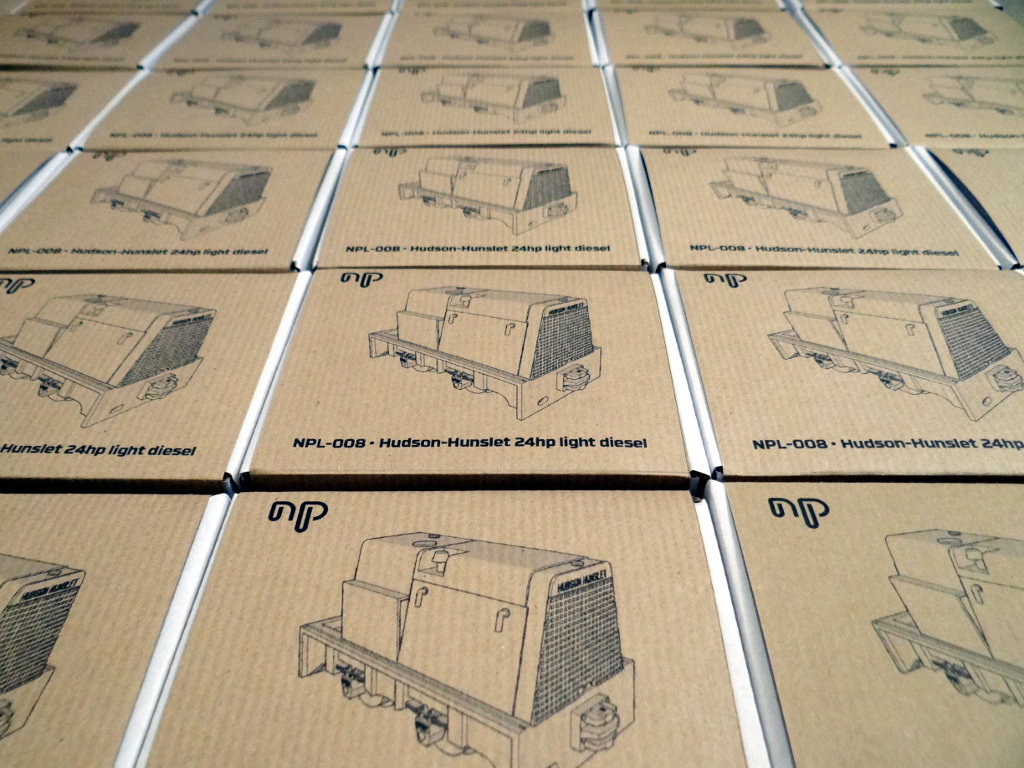
I've now finally finished packing all thirty of the first batch of Narrow Planet kits for my Hudson-Hunslet locomotive. Most of this batch has already been sold although a handful will be on sale on Saturday at ExpoNG. If you've ordered one and are expecting it in the post then I'm just organizing the padded envelopes and should be able to post them out by Monday at the latest.

I'm amazed how popular the kit has been. So popular in fact that we are already planning a second batch!

Thursday, August 13, 2015

A Press Release

Narrow Planet is pleased to announce the release of our first complete locomotive kit, to model a Hudson-Hunslet 24hp Light Diesel Locomotive. Introduced in the late 1950's the 24hp light diesel locomotive was an upgraded version of the company's original 21hp model and was the smallest locomotive in the range. This model, designed by Mark A. Greenwood using Hunslet's General Arrangement Drawing 48937 of April 1961, represents the basic cabless version. Many of the locomotives were, however, fitted with varying designs of cabs, and other equipment, depending upon their intended use. Preserved examples include LCWW18 which is part of the Moseley Railway Trust collection and "Creepy" of the Leighton Buzzard Railway.

Like our previous releases the body is comprised of a 3D printed shell and etched nickel silver detailing parts. Rather than needing to source a chassis, however, this kit includes all the parts necessary to build the complete model. This includes a 3D printed brass chassis block, gears, wheels, and a motor. While the etched detailing parts can all be glued into place a small amount of soldering will be necessary in order to complete the electrical connections. Comprehensive instructions are provided with the kit.

When fully released in November this kit will be produced on demand or in small batches and cost £80. We are intending to produce an initial batch of kits to meet expected demand. To aid in the production of this batch we are asking for a down payment of £30 with delivery expected by the end of October. In return for making a down payment the final cost for each kit in this first batch will be reduced to £75.

Visit the Narrow Planet shop page now to make sure you don't miss out on one from the first batch!

The Minimalist Look

When I first started to design a model of the Hudson-Hunslet diesel my intention was to build a cabless version with the motor and chassis completely hidden within the body. While I've managed this some people have asked me if I intend to also produce a version with a cab. Unfortunately it would appear that every loco that was fitted with a cab has a different cab design. For a first attempt I've gone with a minimalist look, similar to the cab on Macnamara (which is actually a slightly different Hudson-Hunslet design).


Amazingly I seem to have managed to get the cutout in the front panel correct so it fits perfectly over the etched body panel (there were five or six paper based attempts before I committed to the etch but still). Even better it was nice and easy to put together; the roof was shaped by gentely rolling the handle of a small file across it against my leg, pliers were used to fold the roof sides down, and then the front and back panels simply glued into the positioning lines on the roof.

While it all fits nicely, I'm not convinced it's the best cab design. I think of it as the sunhat of cabs; it will keep the sun off but if there is any rain you're still going to get very wet and miserable. Now I know the cutout works though I can have a look at a more enclosed cab.

Sunday, May 17, 2015

Lazy Sunday Afternoon

Since the weekend I visited Rainford when I messed up the pickups on the Hudson-Hunslet there hasn't been much time for doing any modelling. Today though I set myself the challenge of fixing the pickups once and for all.

My hunch was that the 0.112mm phosphor bronze wire I had was perfect as it was springy enough while having a tiny surface area so as not to introduce lots of extra friction. What I realised this morning was that as the wire came as a coil it naturally curves in one direction and so is springier when fitted one way as compared with the other. Last time I think I had it curving away from the wheels as that was the most natural direction given where the pickups are mounted. This time I've fitted it so that it is always wanting to curl towards the wheel instead. Fingers crossed this seems to work really well as even though it moves about a bit as the wheels turn it naturally springs back and continues to press on the treads. With such a light but continuous contact I've found that the slow running has also improved considerably.


So having finally solved that problem I think I'm now happy with all the current prototype parts; the chassis is easy to put together, the etches fit the body print and nicely reproduce the makers name on the front, and it moves as it can collect power! So the next step will be packaging things up as a kit and working out how much interest their is so I can figure out the size of the first batch.

Friday, April 24, 2015

Setting the Bar

As I mentioned in the previous post the newest prototype of my Hudson-Hunslet diesel locomotive wasn't behaving very well and so spent most of it's time at Rainford last weekend in the Narrow Planet display case. This meant though that I didn't need to leave the first prototype on display in the same place. Instead I put it on display in the 009 Society display case which meant it was entered into the modelling competition. Unfortunately I had to leave before the results were announced, although after the judging had taken place. It turns out that people really do like it!


I actually found out earlier in the week that it was awarded runner up in its class (Internal Combustion Locomotives) but it was nice to have the confirmation arrive in the post today. Given that this is only the third locomotive I've finished, in any scale, and the first one I've designed myself I'm really impressed that people seem to like it so much. It does mean that I've set the bar rather high though for any future models I build or design. I'm hoping it wasn't just beginners luck and that I'll be able to hone my skills and maybe one day produce an even better model for the competition.

Tuesday, April 21, 2015

Snug as a Bug

So having received the updated etches I started to build up the second Hudson-Hunslet body. This time I had a deadline as I wanted to take them to the 009 Society AGM held at Rainford last weekend. Unfortunately with pressures of both work and family that didn't actually leave me very much time for modelling. By Friday night though I had a second assembled and painted prototype. Unfortunately when fitting the body to the chassis I managed to mess up the pickups (I actually drew blood by stabbing myself with the end of the pickup wire). I did my best to quickly sort them out and packed both locos nicely in a box for the Saturday.


Unfortunately the damage to the pickups was worse than I had thought and while it did run briefly on James' Creech Bottom layout (thanks James) it didn't behave well enough to earn itself a place on the layout for long and it spent the rest of the day in and out of the Narrow Planet display case as a steady stream of people came and admired it. Many of them also gave lots of useful advice regarding the pickups so I've a few more ideas to try. If you were one of the people I chatted with thanks for taking the time to talk to me. It was a really great day and by far the friendliest model railway show I've ever been to.

I did get the chance to wonder and take a few photos (although somehow I managed not to buy anything) so hopefully there will be another blog post at some point.

Saturday, April 11, 2015

Etch v2

The updated etches for the Hudson-Hunslet arrived in the post this morning (thanks Steve) and at first glance they look perfect.


After the problems with the nameplates disintegrating on the first batch I'd gone for half etched plates which you can see bottom left. Steve thought it was worth a second go with a slight adjustment. Basically the idea was to combine the grill and nameplate and to tweak the lettering slightly to give more surrounding metal to help keep things together. You can just see this attempt top right of the full etch but it's obviously clearer on the closeup shot.

As you can see we tried a couple of approaches for a single part, but the top right is just perfect; it's etched through and still keeps the grill forward of the nameplate. In other words, SUCCESS!

The other problem with the first etch was that the folded part didn't fit properly as I'd drawn it wrong. A quick check and that problem seems to have been solved as well, so I can now start building up a second body.