Showing posts with label books. Show all posts

Tuesday, September 27, 2022

I Stand in Awe of...

As some of you may remember, back in 2018/2019 I designed a new Narrow Planet kit so that I could have a model of one of Alan Keef Ltd.'s K12 diesel locomotives; specifically AK6 of 1981. Having finished my model and produced the kit I then wrote two articles for Narrow Gauge and Industrial Railway Modelling REVIEW; one detailng the model and one the K12 class of locomotives. For that second article I was lucky in that I managed to persuade Alan Keef to write it with me. As the K12 was the first new locomotive design Alan Keef Ltd. produced the K12 class covered works numbers 2 to 7. Not long after that article was publshed (see issue 119 f the REVIEW) Alan told me he was going to continue documenting the locomotives the company had built. Originally he was intending to cover the first 100 locomotives, but a global pandamic got in the way, and instead he was able to cover the first 50 years of the company instead which amounts to 119 locomotives.

Having waited three years to see the book appear it was great to finally get hold of a copy on Saturday. Entitled "Half A Century of Locomotives from Alan Keef Ltd 1972-2022" and published by Lightmoor Press it's a nice hardback running to 160 pages, and was well worth the wait.

Looking at the cover it's nice to see a photo of AK6 (middle left) given that was the start of the journey for me building the model and then writing the article with Alan. Alongside the main content of the book are three pages towards the end which look at models people have built of the companies locomotives, and not only does that include my model of AK6 but the following lovely caption:

I stand in awe of Mark Greenwood for this model of a "K12", specifically AK 6, with a peat wagon in tow. Even this picture may show it as bigger than the actual model, as can be seen from the shot below of the locomotive alongside a 20p piece!
As you can probably imagine reading that for the first time made my day. I model first and foremost for myself, but it's nice when someone else appreciates my modelling or when I can make some of the things available as kits for others to enjoy.

Wednesday, October 15, 2014

The Sand Hutton Light Railway

So my Trevor Quarry breaker wagons seems to go down well if the comments to the previous post are any indication. I've been really enjoying modelling the small wagons and based on a comment to that post I've been side tracked from Canopus yet again. The comment in questions was from James who suggested that maybe I'd be interested in having a look at the wagons from the Sand Hutton Light Railway. No sooner was the suggestion made and I was on the hunt for scale drawings.

Actually that's not entirely true, I knew where the scale drawings were, they were in a book that I'd been tempted to buy ever since I picked up a copy of the Slate Quarry Album to get scale drawings for a bunch of Welsh slate quarry wagons (like the ones for the Aberllefenni box wagon). The publisher of that book, RCL Publications, also have a book on the Sand Hutton Light Railway and James' comment was a good excuse to buy a copy.

The book only arrived today so I haven't had a lot of time to read through it but it looks like an excellent book with lots of photographs, maps, and scale drawings. In fact while I haven't read much of the book yet, I've already started on a model of the open goods wagon! I'd certainly recommend the book to anyone with an interest in narrow gauge railways.

From the small amount of text I have read so far I've learnt a number of things including that there is a link between the railway and my home town, but more on that in a later post when I've done a little more research as I'm going to finish this post so I can get back to the 3D model I'm building!

Monday, September 1, 2014

Heath Robinson

Now before anyone gets any ideas, Heath Robinson is not a description of my attempt at building the gearbox for Canopus. I've actually not done any more work on Canopus since the previous post as we've been away on holiday.

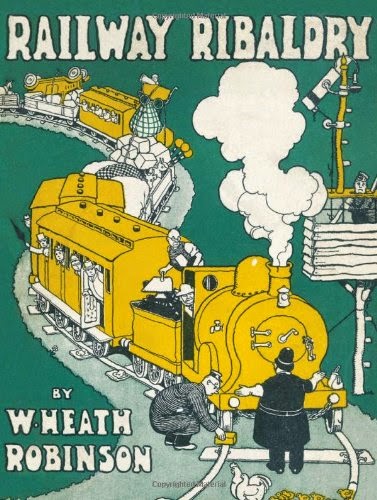
Even though I don't have any modelling updates to report, I thought a post was in order, and fortunately one of my recent birthday presents gives me something to blog about. I actually got two railway related presents, but you'll have to wait a bit for details on the second one. Today I give you a very brief review of Railway Ribaldry by W. Heath Robinson.

This clearly isn't a new book, the author died in 1944, but is a new reprint of a book originally published in 1935 to commemorate the centenary of the Great Western Railway. As you would expect, the book is a series of cartoons or illustrations showing weird and wacky railway inventions. It's not a long book, there are about 100 drawings, but it is certainly amusing and this nice quality reprint (it's not a cheap paperback just put out to make money) does the original justice.

Tuesday, May 20, 2014

The Railway Traveller's Handy Book, 1862

So it's now been well over a week since I showed you any real modelling and I'm afraid the wait will go on a little longer. It's not that I haven't been doing any modelling, but rather that I don't currently have anything at a stage where I want to talk about it for one reason or another. I still think you all deserve a new post though for putting up with my ramblings so how about a short book review?

Some of you may remember that for my birthday last year I was given a reproduction of the 1863 copy of Bradshaw's Handbook. This fascinating tome gives lots of interesting details about the places served by the railways, but it doesn't tell you how to prepare for a trip on a Victorian railway. Fortunately the book I'm currently flicking through, The Railway Traveller's Handy Book, explains everything you need to know to travel on the railway should you find yourself in 1862. It's split into three sections for before, during, and after the journey, with each of those broken down even further. For example, there are sections on packing, the choice of carriage, smoking, meeting friends, and engaging a cab.

As I said I'm still working my way through the book, but so far it's a fun read that gives a glimpse into how the Victorians viewed the railway.

Saturday, September 21, 2013

Penistone Is...

As I mentioned in the previous post many of the presents I received for my recent birthday were railway related, many of them were also books. One of those books was a modern reproduction of the 1863 copy of Bradshaw's Handbook. This is the same version as Michael Portillo uses in his Great British Railway Journeys TV Series -- strangely this isn't a programme I've ever actually watched.

George Bradshaw is best know for publishing railway timetables, but he also published a number of guides to the places the railway lines passed through. While there were a number of versions of these guides, as I mentioned above, this particular book collects together the four volumes and reflects the railway as it was in 1863. Given that both the Manchester, Sheffield and Lincolnshire Railway and the Yorkshire and Lancachire Railway had both reached Penistone by 1863, the first thing I looked for was an entry for Penistone.

I eventually found Penistone on page 52 of part 4 and it would appear that Bradshaw (or more likely someone working for his company, as he died in 1853) didn't really think much of the area as the full entry reads:

This is a small market town, situated on the banks of the Don, in the midst of a wild and dreary district. It contains several large cotton and woollen factories, and a free Grammar School.
Today Penistone is a still an active market town set in wonderful countryside that I challenge anyone to call dreary, even when the weather is miserable!

We'll have to see what Michael Portillo thinks of Penistone when series 5 of Great British Railway Journeys airs on TV. Although the list of journeys hasn't yet been announced my next door neighbour saw him with a TV crew a few stations up the line earlier in the summer.

Tuesday, February 5, 2013

Suddenly!

Who would have thought as they bade her "Good-bye," that on earth they would never meet again?
Loved ones gathered round her at the railway station. "You are not nervous?" they asked anxiously, "it is a long way to go alone."
"No," she had answered cheerfully, "why should I be? I am in good hands, in safe keeping," and with fond farewells they parted.
The train moved on, and mile after mile of fair verdant country was safely passed, until, with an awful crash, a sudden railway accident brought death and suffering in many a ghastly form among the passengers.
That quote is the opening page and a half from an odd little old book I picked up on eBay entitled "An Incident of the Penistone Railway Accident". Given it's title I had assumed that it would probably be an account of one of the many accidents that occurred on the railway around Penistone; either a personal account or something pulled together from newspapers clippings etc. What it actually turned out to be was a religious tract! The above quote is the only mention of railways within it, and Penistone is only ever mentioned in the title.

The title page gives the full title as "Suddenly! An Incident of the Penistone Railway Accident" and describes the book as "Being No. I, Fourth Series, of Pleasant Stories for the Young". While it lists the publisher as "G. Morrish, 20, Paternoster Square, E.C." it doesn't give a publication date, although a web search led to a Google Books page which lists it as published in 1887. Interestingly my copy seems to have been to the states and back if the sticker in the front, which reads "Loizeaux Brothers, Importers, 1 E. 13th St., New York", is to be believed.

The frontispiece is actually a nice engraving, unfortunately I think the publishers didn't pick the illustration for any reason other than aesthetics. To my eye the proportions of the locomotive look wrong -- the engine looks too wide for it's height. In fact I think the image depicts a broad gauge locomotive (the rails being 7ft 1/4in apart rather than the standard gauge of 4ft 8 1/2 in) which explains why it looks much wider than I would expect. From a bit of digging around the nearest match I can find is to the Great Western Railway (GWR) Star Class locomotives -- Northern Star being a good example as the photo to the left (taken by Tony Hisgett) shows. Northern Star isn't a perfect match to the drawing but it's pretty darn close. Strangely though all members of the class had been withdrawn by 1871, 17 years before I think the book was published, so it wouldn't have been a particularly up to date illustration. Which ever class of locomotive it was meant to represent, if we assume that it is a broad gauge locomotive then it certainly doesn't depict any engine that ever passed through Penistone as the GWR never ran a line into Penistone, and none of the companies that did laid broad gauge track.

All in all, it's an odd little book that has nothing whatsoever to do with Penistone or any of the railway accidents that did occur in the area, so why use Penistone in the title? I think I know the answer but that will have to wait until a future blog post.