Showing posts with label history. Show all posts

Thursday, June 3, 2021

Oh, dear! wherever is the train?

I first wrote about the Bullhouse Railway accident back in 2013 and have writen short updates a number of times since. I've now pulled all that research into a single article but rather than publish it here I wrote it as a guest post for the Railway Work, Life & Death project.


Even if you've read all my previous posts about this accident you should find something new in this longer version as I spent quite a bit of time finding more contemperaneous newspaper reports to try and give a more detailed first hand account of the accident and it's immediate aftermath; lots of graphic descriptions of death and mutilation!

Friday, August 18, 2017

Salvage

It's been quite a while since I last published a local history post (I got distracted by Scottish grouse shooting railways) but a new photo has come to light that shows a different view of one of the local railway accidents I've talked about before; specifically the Bullhouse Railway Accident which occurred on the 16th of July 1884..


All the previous photos I've seen of the accident site have been taken from below the railway line showing the carnage in the road and fields. This photo though is taken from the Penistone side of the bridge looking down into the road. It would appear that rather then showing the direct aftermath of the accident this photo shows the cleanup and possible salvage of useful parts from the destroyed wagons and carriages; note that the upturned carriage is missing it's wheels.

Thursday, January 26, 2017

21 Pages

Some of you may remember that way back in July of 2015 I started work on a small diorama depicting a disused railway bridge. I built the model as an entry into that years Dave Brewer Memorial Challenge held at ExponNG at the end of October.


Over the roughly three months I spent working on the model I learnt an awful lot of useful and interesting techniques, and while I'd documented them on the blog I thought that, even though I'd not won the challenge, an article on the building of the model might be interesting to a wider audience than this blog enjoys.

Having written for Narrow Gauge & Industrial Railway Modelling REVIEW before I ran the idea past the editor, Roy C. Link, who agreed it was an interesting topic for an article. My original plan was to put an article together fairly quickly by pulling text and images from some of the blog posts I'd already written. Clearly things didn't quite go to plan as it took a year before the article was finished, but it finally appeared in the most recent issue (109) of the REVIEW.

It wasn't that I was particularly slow in writing the article, in fact as I hoped it would it started to come together quite quickly from the posts I'd already made. What happened was that I decided to include a little more of the history of the bridge and the railway it was part of in the article and once I started to do some research things kind of snowballed.

What I discovered was that the line over Duchal Moor was one of only two railways in Scotland, the other being at Dalmunzie, that had been built to aid access to grouse shooting moors. So my research expanded from a derelict bride to two entire railways and as such took a lot longer than planned. It also resulted in more details emerging than would sensibly fit in an article that was predominately about a small diorama so it became two articles; one on the modelling of the bridge and one entirely devoted to the history of the two lines.

Given that both lines were closed or abandoned over thirty years ago and neither were ever open to the general public tracking down enough information to produce an interesting article took some time. I was very fortunate that requests for information in a couple of places turned up people who had either visited one or other of the lines, or had useful photos and documents which they were willing to share. The result was a 12 page article including a detailed history of the lines and rolling stock, maps, and a number of previously unpublished photos. Of course these 12 pages are in addition to the 9 page article on the bridge model, hence the title of this post as issue 109 of the REVIEW contains 21 pages of my work. Viewed another way, assuming my maths is right, about 45% of the magazine is stuff I put together, so hopefully people will enjoy both articles; it's worth buying for the other 55% alone!

If you are interested in reading the articles then you'll have to pick up a copy of the REVIEW as I can't simply repost all the material here (you should be able to get issue 109 as a back issue shortly) but I do have one thing to share with you all.

When researching the line at Dalmunzie I came across an old cine film which had already been digitized and uploaded to YouTube. The entire film is made up of a number of reels shot over a number of years and shows life on the Dalmunzie estate. While the whole film is interesting if you are only interested in the railway then there are three clips at 8:30, 29:50, and 30:40.


Monday, July 20, 2015

Duchal Moor Railway

When I originally started work on a bridge for the Dave Brewer challenge I wasn't sure if I was going to copy an existing bridge or just use one for inspiration. That is why, until now, I've specifically not mentioned the bridge I'd been looking at. Of course, as comments on recent posts have shown, it's difficult for any of you to make comments on how accurate something I've modelled is if you have no real idea of what it should look like, so......

The Duchal Moor Railway, known locally as the Grouse Moor Line, was built by the shipbuilder James Lithgow to help transport people and equipment out to the shooting butts on the moor. When completed in 1922 there was approximately 7 miles of 2ft gauge track. The railway closed in the late 1970s and most of the line has disappeared back into the peat bogs it was built over. One of the remaining sections of the line includes a bridge over Blacketty Water which I'm using as the basis for my model.


Clearly it's not a particularly big or complex bridge but I was looking for something that I had a could model with a chance of finishing in time, and which would also let me experiment with a bunch of new techniques. To follow up on the question of sleeper size here is a comparison of the test piece of track and the real track.


Having measured from the photo, I think the majority of the sleepers are around 2' 9" wide but I've modelled them as 3' (so 12mm) to give a little more width. Even with the extra width they look very narrow due to the over sized spikes and heavier rail. Given there is not much I can do about the rail or the spikes (I really couldn't handle smaller spikes) I think the track looks like a reasonable representation, especially as when viewed from a normal distance the spikes blend in more than they do in the close up photo. I suppose the other option would be to just glue the rail down and not bother with the spikes given how small they are in real life but somehow that seems like cheating.

Anyway, now you all know what bridge I'm basing my model on hopefully you'll keep making helpful comments as I continue experimenting and then building the final model.

Sunday, May 31, 2015

Clayton Battery Electric Locomotive No. 5843

While work is still ongoing to turn the Hudson-Hunslet into a kit I've already started work on designing another model. As with the Hudson-Hunslet I've picked something with local interest; this time to where I live now rather than where I grew up.

As I've mentioned a number of times before the Penistone line from Hudersfield to Sheffield runs along the bottom of our garden. Until 1981 the line also formed part of the Woodhead route between Sheffield and Manchester. The line to Manchester branched from the current line at Penistone and climbed into the Peak District where it entered a tunnel at Dunford Bridge before reappearing at Woodhead and continuing to Glossop and on to Manchester. Since the line originally opened in 1845 there have been three parallel tunnels built. The original tunnel was joined by a second one in 1853 and a new tunnel replaced both of these in 1953 when the line was electrified. When the new tunnel opened in 1954 the two Victorian tunnels were closed and the track lifted and they remained unused until 1966.

In 1963 the Central Electricity Generating Board (CEGB), now known as the National Grid, announced that they wanted to construct an overhead power line linking Thorpe Marsh power station in Yorkshire with Staylbridge in Cheshire. There was significant public objections, however, to allowing pylons to be built within the Peak District and eventually the CEGB decided to route the cables through the old Victorian railway tunnels. As part of this work a 2 foot gauge railway was installed within the northern of the two tunnels to ease access. A number of locomotives have worked this line but my interest has been caught by Clayton battery electric locomotive works number 5843 which was a one off variant of a standard Clayton design using larger wheels to give a higher top speed.


The locomotive was delivered new in 1971 and withdrawn, I believe, sometime during the 1990's. It's now owned by the Moseley Railway Trust who purchased it in 2000. Amazingly these two photos are the only colour images I've been able to find of it in use prior to preservation (there is a black and white photo in issue 77 of the Industrial Railway Society journal). It's not just photos of the locomotive that are hard to find though. Given how much interest there is in the standard gauge Woodhead route I can find almost no published accounts of the 2 foot gauge railway that replaced it. I'm guessing this is mostly due to only short sections at either end of the tunnel being visible to the public and both of these are in fairly out of the way places. If you happen to know of any more details on the line, the locos or the rolling stock I'd appreciate it if you could leave a comment.

Fortunately, while details of it in active use might be scarce I already had a set of drawings done by Jeremy Tilston in 2005 and these have allowed me to make a start on a model. Currently progress is only virtual as I'm again intending to 3D print the majority of the model.


There are still a few details to add before I order a print but the render on the left seems to be a good representation. My plan is to print it in two halves; a chassis (in orange) to which all the mechanical parts will be fitted and then an upper body (in yellow) which will slide over the motor and be secured by two screws. What you can't tell from the images is that this model is in a new scale for me.

I really wanted to produce a model of this locomotive in OO9, the same scale as the Hudson-Hunslet, unfortunately it just wasn't possible. On the Hudson-Hunslet the motor just fitted within the bodywork, unfortunately on this locomotive there isn't enough space in OO9 to fit even a 6mm x 10mm motor horizontally within the body and if fitted vertically the driveshaft would be almost touching the rail and two low to drive the layshaft. This means I've had to move up a scale and this model is designed for O14. For those not familiar with this scale it models narrow gauge in O scale (7mm to the foot) using 14mm gauge track. This has the advantage of being an accurate representation of 2 foot gauge railways. Even in this larger scale the model is very small and in fact won't be much bigger than the OO9 Hudson-Hunslet!

Of course having never modelled in O14, or any scale larger than 4mm to the foot, I'm going to have to see what modelling skills work in a larger scale and which need some more thought. I'm also going to need to build some 14mm gauge track to test it on. I can see months of fun ahead!

Sunday, February 8, 2015

Is There a Point in All This?

So having built the track for my Hudon's Pizza layout and bought a baseboard I've now come to a bit of a halt while I decide what to do with the extra space available. If you remember back to when I first introduced the idea for this layout I showed both a map and an aerial photo of the test track.


Both of these seem to show that the test track is completely isolated from track anywhere else in the works. Given that Hudson's did deal in portable railway systems I'm guessing they were use to having to manhandle rolling stock, but it does seem kind of odd that at their works they wouldn't have made access to the test track easier. I also have a thread over on NGRM about the layout (you have to sign up to be able to read that link unfortunately) and on there someone suggested that maybe there was a point on the test track with rail leading off to the top left. As hard as I looked I couldn’t see anything though.

You'd think, given how much railway equipment Hudson's produced, that it wouldn't be too difficult to find photos of their main works which would clear up the issues regarding how the test track was used. Unfortunately the only other photo that has turned up is this one, which appeared in NG&IRM issue 36.


Certainly from an initial glance this photo of a 'Ganges' class 0-6-0WT doing laps of the test track doesn't exactly show a lot of detail. Upon taking a closer look though I started to notice that what looked like rails to the top left of the locomotive wouldn't match up with the rails just in front of it. To see what I mean here are two cropped and zoomed versions of the loco and on the right hand one I've drawn red lines over anything I think is rail.


So, if everything I coloured red is definitely rail then there is no way they join up in a complete circle, which leads me to the conclusion that I'm looking at a point leading off the test track. Given that my layout was always going to be inspired by rather than a reproduction of the works I now have to decide what I want to do. On the one hand I have a circle of track built and ready, but on the other hand I've got space for a little more track, and if I can avoid having to resort to the "hand of God" to change stock on the circle of track that would be nice. The problem of course is that I've no idea if I'm capable of building a working point. Plain track I think I've mastered well enough for it to work reliably but a point is a whole different game, made more so by the very tight radius of the circle it has to fit into. I'm not going to make any decisions yet, but I think I am going to have a go at building a working point (will be useful to know for future layouts if I can build one) and then see where that leads me. It does of course mean that there is unlikely to be any scenic work on the new layout for quite some time.

Saturday, December 6, 2014

Hudson's Pizza

So the time has finally come to unveil the plan for my next layout. Given that I'm still not happy with the track plan for 77 Box Lane that will stay on the drawing board for now, and this is an entirely new and different layout.

One of the things I liked about my N gauge layout, Jerusalem (which is now boxed up and being stored in the loft) was that it had a roundy-roundy track plan so I could just watch the trains go by. It was also useful for running in and testing new locomotives as they could be left going for hours if necessary without any intervention. Given the size I had to play with 77 Box Lane was always going to be an end-to-end layout and while I'm happy with that (although not the current track plan) I did feel it would be useful to have some form of continuous run test track, even if that was a simple circle of temporary track.

I wasn't actively planning a new layout when a random comment sent me off on a bit of historical research. I grew up in Morley, a small town just outside Leeds, and I've known for a long time (pretty much as long as I can remember) that many of the early builders of locomotives and rolling stock were based in and around Leeds; it's one of the reasons I have a soft spot for the Quarry Hunslet locomotives. What I didn't know, until recently, was that I actually grew up less than three miles from the main works of one of the companies.

Robert Hudson Ltd was founded in 1865 and had it's main works at Gildersome a small village just outside Morley (it's officially been part of Morley since 1937). This was a huge site covering 38 acres and was well served by a 2 foot tramway. Raw materials and finished products arrived and left the site via the standard gauge branch line that formed the northern edge of the site. You can see these and many other details on both the 1938 map and a 1928 aerial photograph.


What immediately caught my eye though was the circular feature which is very clear on the map, but unfortunately is unlabelled as to purpose. Zooming in on the photo though and it's purpose becomes clearer. It's a circular test track on which you can see what looks like a couple of wagons.


To me this looks perfect for turning into a pizza layout. It will give me somewhere to test and run in locomotives and wagons while being based on an actual location. There also appears to be a variety of building styles to perfect and some dry stone walling. I know that so far I've not built any Hudson wagons or locomotives which they re-sold (they didn't build their own but rather re-sold those produced by companies such as Hudswell Clarke, Kerr Stuart, and Hunslet) but I can always apply Rule 1 of railway modelling; it's my trainset so I'll run whatever I want to!

The problem I have is that this grainy photo contains the only details I have on the buildings surrounding the test track. There is a drawing in Alan J. Haigh's book on the foundry (published by the Moseley Railway Trust) but it doesn't provide any extra details. So does anyone know of any further drawings or photos of that area of the works that might show more details of the buildings. If you do please leave a comment.

From some rough measurements, I believe that I can fit the circle of track and the buildings immediately surrounding it onto a board that will fit into the box I originally bought for Jerusalem but which was about 1cm too small. So this means it will fit on my desk and I'll have storage for it. The next step will be a full scale mockup (starting from the map) to check everything will fit and then I can make a start on the baseboard and then building some track. This should be fun!

Sunday, October 26, 2014

The Rails Were For...

All the way back in May of 2013, I blogged about the odd set of narrow rails you could see if you visited my local DIY shop. Unfortunately the road has since been resurfaced and the rails can no longer be seen.

The DIY shop is housed in what was, according to old maps, a wagon and wheel works and in the previous post I speculated that, for want of any other information, that the rails might relate to some form of travelling crane. Well I was wrong.

I've now, thanks to issue 190 of the Industrial Railway Record, that the works were the premises of William Gittus & Son Ltd. It appears that in general most of the work involved repairing wagons rather than building new ones, but they had a very distinctive builders plate featuring a dog which they attached to the wagons they worked on.

While it is nice to be able to put a name to the company that ran the works, the article also clears up the issue of the rails...

by 1905 several developments had taken place ... a large wooden building (which could accommodate six wagons and was known to the workmen as the "big shed") was constructed on the west side of the dike. The big shed had a full length traverser at it's west end and was served by four sidings. ... Further expansion took place in the 1920s when extensions were made to the Big Shed and a second similar sized building was erected on its west side. The traverser was then situated between the two shops and two horses were employed to shunt in this area.
So we now have a definitive answer, the rails were the remains of the wagon traverser.

Monday, July 28, 2014

Canopus

In 1901 Manning Wardle of Leeds built an 0-6-2ST locomotive for the Pentewan Railway in Cornwall. The locomotive, named "Canopus" arrived in December of 1901 and was immediately put to work hauling china clay along the railway. The railway didn't usually carry passengers although during the summer it was noted for the annual Sunday School Tea Treat Trains when the churches and chapels around the area hired the railway for the afternoon and conveyed their scholars, family and teachers to the coast at Pentewan. Canopus continued to work the line until it was abandoned in 1918. Canopus was eventually sold for scrap in 1924, but not before working as RAF loco No.7 at RAF Manston apparently on the construction of two underground hangers.

After a bit of searching I've managed to find just two photos of Canopus; one clearly showing her in use by the RAF and the earlier photo which I'm guessing was taken on a Sunday showing one of the church outings.


By this point you might be wondering why I'm suddenly blogging about a locomotive built for a small Cornish railway which no longer exists. Well, Canopus will be the second OO9 steam locomotive kit I'm going to attempt to build. The kit is from Backwoods Minatures, and from a brief look at the parts it seems as if it is a really well thought out kit that even I should be able to assemble. It will certainly be more difficult than the Brian Madge Quarry Hunslet kit I recently built as I have to build the full chassis rather than building a model around a pre-assembled motor bogie.

In a similar way to the naming of the Quarry Hunslet, I'm not intending to build a replica of Canopus rather, another loco to the same design, with a sensible backstory explaining how it ended up in the bottom left hand corner of Yorkshire. Even though I 'm not building a replica of Canopus, I'd be interested in any other photos, drawings, or livery details that people might have as they can only aid in construction of the kit, which will of course be the topic of quite a few future blog posts.

Saturday, July 26, 2014

Still Innocent

Last week I spent a few days working in Edinburgh. You may remember that I've been to Edinburgh with work before when I discovered the Innocent Railway. On that occasion I only walked a short distance along the railway as I used it as a way of getting to the pub where we were having dinner. On this visit I was determined to try and see a little more of the line.

Having spent nearly five hours travelling to Edinburgh by train on a very warm day I decided that getting some fresh air by heading out of the city along the railway was a very good idea, so off I set. Access to the line starts at an old goods shed about five minutes from my hotel (see the previous post for more details). Once you've passed the shed you really wouldn't know you were walking along an old railway line as these photos nicely illustrate.

Originally this area was covered with lots of sidings as it was a large coal depot as well as a station. As you can see, today the area is covered in flats instead. In the second photo, if you look past the garages you can just make out the entrance to the tunnel which was one of the main features of the original line. Given that this time I was carrying my proper camera (not the tiny point and shoot thing), and it was well charged, I thought I'd shoot video as I walked through to the other side.


Okay, so that video is rather long and boring, but it's a tunnel what else did you really expect?!

Anyway once you leave the tunnel you are out of the city and into the countryside. Looking back you can see how the tunnel is cut through solid rock at the base of Arthur’s Seat. This is the point at which I left the railway on my previous visit, but this time I kept going.


It's not long before the walls get taller and the railway must have been a fairly tight fit, although I'm sure a train thundering past in the tight confines of the walls would have been impressive. Continuing on and there are the supports for a bridge that has long since disappeared. Looking at an old map it appears it was a foot bridge that simply linked the two fields at either side of the railway, I assume to give the farmer access.

From my research after my last visit I knew that as well as the tunnel and engine shed there was one more important piece of remaining infrastructure, a cast iron bridge, which I was determined to find. Fortunately if you just keep walking you can't miss it.


According to the sign on the wall the bridge spans 18ft and was erected and painted by the Shotts Iron Co. in March 1831 for the grand total of £133.10s. It goes on to say that the bridge "originally extended over the full width of the railway -- from wall to wall. The beams which are curved in top elevation are of 'L' and inverted 'T' cross-sections. They are of outstanding interest as being amongst the earliest surviving examples of their type anywhere". I assume the comment about extending the full width of the railway means that originally the wooden section spanned the entire bridge, and the tarmac covered sections are modern safety features.

I could have kept going along the railway, but I'm not sure what else there is to see and anyway I had to head back to my hotel to get some work done before meeting a colleague for dinner.

Tuesday, May 20, 2014

The Railway Traveller's Handy Book, 1862

So it's now been well over a week since I showed you any real modelling and I'm afraid the wait will go on a little longer. It's not that I haven't been doing any modelling, but rather that I don't currently have anything at a stage where I want to talk about it for one reason or another. I still think you all deserve a new post though for putting up with my ramblings so how about a short book review?

Some of you may remember that for my birthday last year I was given a reproduction of the 1863 copy of Bradshaw's Handbook. This fascinating tome gives lots of interesting details about the places served by the railways, but it doesn't tell you how to prepare for a trip on a Victorian railway. Fortunately the book I'm currently flicking through, The Railway Traveller's Handy Book, explains everything you need to know to travel on the railway should you find yourself in 1862. It's split into three sections for before, during, and after the journey, with each of those broken down even further. For example, there are sections on packing, the choice of carriage, smoking, meeting friends, and engaging a cab.

As I said I'm still working my way through the book, but so far it's a fun read that gives a glimpse into how the Victorians viewed the railway.

Wednesday, November 20, 2013

L&YR 2-4-2T No. 1008

When I visted Barrow Hill back in September, one of the things I blogged about were the new and upcoming releases from Bachmann that were on display. Of particular interest to me was the 2-4-2T that John Aspinal designed for the Lancashire and Yorkshire Railway. On my recent trip to the National Railway Museum I managed to photograph the only preserved member of the class, number 1008.


According to Barry C. Lane's excellent book on the L&YR, number 1008 was actually the first of the type to be built and entered service in February of 1889. It was renumbered as 10621 when the L&YR became part of LMS and then 50621 under BR ownership before eventually being withdrawn in September of 1954. As far as I can tell she is currently displayed with her as built livery, as the front buffer beam includes the locomotives number and this practice didn't continue after the middle of 1891.

I really like this locomotive and I think, had more been preserved, they would have been an ideal size for working passenger services on many of the UK's preserved railways. As it is, if we want to see this locomotive move then we will have to make do with a model, and while space constraints have left me currently modelling in N gauge, I couldn't resist this exquisite OO gauge model.


As I mentioned in a previous post the Bachmann model will be widely available in a number of liveries (which will be available some time next year I believe) but the L&YR liveried model is exclusive to Locomotion Models (the modelling arm of the National Railway Museum). Given that only 500 models were being made in this livery I pre-ordered mine at the earliest opportunity. If I never go back to modelling in OO then a mint condition boxed example should keep its resale value so I'm considering it a good investment come what may.

I don't currently have the space to even temporarily lay out an oval of OO gauge track so I can't tell you anything about the running qualities of the model, but I can tell you that as a static model it is superb. I'm not even sure that a rivet counter would find much to complain about with this model. I've taken some detail shots (yes I should have dusted first) so you can get a sense of just how good it is.


If I had to find something to complain about then, for the price of the model, etched brass number plates would have been nice, especially given that I know they are possible to produce, but the printing of the number plate detail is so crisp and well applied that from a distance you wouldn't know they weren't etched. What truly amazes me is the level of detail included on areas that are impossible to see when in use; the leaf springs behind the driving wheels being the main example (bottom right picture) as these can't be seen when the train is on the track.

All in all an exquisite model of a wonderful locomotive. If you want one in L&YR livery then hurry over to Locomotion Models because as of this moment there are only 11 left and I doubt they will be available for long.

Tuesday, November 19, 2013

EM1

When it comes to railways I'm definitely a steam person. In fact I've yet to find a diesel or electric locomotive that inspires me in any fashion. Having said that I am, however, also interested in the history of the line that runs along the bottom of the garden and so I'll make an exception for the EM1. The EM1, which stands for Electric Mixed-Traffic 1, was specifically designed and built for the Woodhead line. They were powered from 1.5 kV DC overhead catenary and employed regenerative breaking to actually feed power back into the system when running downhill. They were predominately used for working freight trains through Penistone as this photo from 1955 shows.


The photo shows number 26020 which coincidentally is the only preserved member of the class and which I photographed at the National Railway Museum when I visited for The Great Gathering.

If you want more details on the EM1 then Wikipedia has a fairly informative page, and if you fancy one in model form then Heljan produce an OO gauge model exclusively for Olivia's Trains.

Thursday, November 14, 2013

Cool Runnings

This post focuses on another, of the many, railway accidents to have occurred in and around Penistone (see here and here for previous posts on this topic).

At 7:53am on the 1st of January 1885, eight minutes after the scheduled departure time, a special excursion train to Liverpool and Southport left Sheffield. The train should have reached Penistone at 8:20am but at 8:26am it was travelling at around 20 miles an hour as it passed Barnsley Junction signal box approximately half a mile south of Penistone station (see the 1894 map to the right).

At approximately 8:21am a goods train, of mostly empty wagons, left Penistone goods yard heading south through Penistone station. After passing Huddersfield Junction signal box, with the steam off, the train was travelling at around 12 miles an hour as it headed towards Barnsley Junction.

By 8:27am two people were dead, two fatally injured, and a further 47 had suffered minor injuries.

The full details of what happened between 8:26am and 8:27am on the morning of the 1st of January 1885 come from the official accident report compiled by Major F. A. Marindin, who had also been responsible for the report into the accident at Bullhouse Bridge the previous July. Unlike that accident I haven't been able to find any other contemporary reports or photographs, but the official report runs to ten full pages and is packed with eye witness and expert testimony.

Before we can fully understand the accident report we need to understand the makeup of each train as specific carriages and wagons are referred to throughout the eye witness evidence. Firstly we have the passenger train that was heading from Sheffield to Liverpool and Southport. It was being operated, as was the goods train, by the Manchester, Sheffield and Lincolnshire Railway (MS&LR) company and consisted of an engine and 18 carriages (note that I'm using break instead of brake as this is the spelling used in the original report):

  • 0-6-0 tender engine #229 (John Coldwell driver, John Healey fireman)
  • third class break #407 (under-guard Jacob Hanby)
  • third-class #452
  • third-class #417
  • third-class #255
  • composite #96
  • third-class #470
  • third-class #466
  • third-class #109
  • third class break #463 (head guard Joseph Plowright)
  • third class break #499
  • third-class #331
  • composite #98
  • third-class #657
  • third-class #188
  • composite #102
  • third-class #230
  • third-class #400
  • third class break #516 (head guard William Spinks)

The reason for two head guards being present is that each was in charge of a separate portion of the train. William Spinks was in overall charge as well as being head guard for the nine rear coaches which were destined for Southport, while the front nine coaches, which were destined for Liverpool, were under the oversight of Joseph Plowright.

There are slightly less details about the makeup of the goods train and I don't have running numbers for all 26 wagons. The details I have managed to deduce from the report are as follows:

  • 0-6-0 tender engine #464 (John Schofield driver, Edmund Peacock fireman)
  • MS&LR goods wagon #582 (the only loaded wagon, which was picked up at Penistone)
  • five empty Shireoaks waggons (numbers 98, 575, 1, 218, and 219 all picked up at Hadfield)
  • five empty Kiveton Park Colliery wagons (numbers 504, 413, 227, and 543 all picked up at Ardwick)
  • two empty wagons for Whaleswood belonging to A. Lawton (picked up at Ardwick)
  • four empty Shireoaks wagons (picked up at Old Dinting)
  • nine empty Shireoaks wagons (picked up at Ardwick)
  • break-van (guard Robert Higgs)

As you can see both trains were recorded as being pulled by 0-6-0 tender engines (number 229 and 464 respectively) and while I don't know for certain, I'm assuming that they were both of the same design, what would later be referred to as GCR Class 18, as this appears to have been the only class of 0-6-0 tender engines in use by the MS&LR at the time of the accident (if anyone knows differently please do let me know).

From the report it would appear that Robert Higgs, the guard on the goods train, was the only one to fully see the accident unfold. He had this to say in his evidence to the commission:

I was looking out ahead on the left-hand side, and I saw fire flying from a waggon, I think the fifth from the engine. I then saw the waggon oscillating very much. I then noticed it taking to the 6-foot way, and the wagon behind it followed. I then saw a waggon mount up. At that time time the engine of my train and the engine of the passenger would be about passing each other. I then saw the passenger engine strike one of the waggons, rearing it up on end, back towards my train. The waggon then fell back into the passenger train. I had put my break on as soon as I saw the fire flying. At that time I had not noticed the passenger train. It all happened quicker than it would take to tell.
The driver of the passenger train, John Coldwell, gives a similar account in his evidence:

When I first saw the mineral train the engine was over 100 yards away, and at that time I saw nothing wrong with it. When the engine was about 20 yards from me I saw a waggon (which I thought was the fifth waggon) was running on the 6-foot. I cannot say that I saw this waggon actually leave the rails. ... I shut off steam at once and applied the vacuum-break, and my fireman at the same time applied the tender-break. Both breaks were hard on before my engine struck the waggon which was in the 6-foot, and I think that before the collision took place the speed of my train had been reduced to nearly half the speed at which we had been travelling. ... Just before the collision I saw the waggon which had been running in the 6-foot work into the 4-foot of the down line. I struck it with the front of my engine, so that the smoke-box door was driven in. As my engine struck it I bent down on the foot-plate, as I thought the waggon might come over the engine, so that I cannot describe what followed.
Head guard, William Spinks, who was travelling in the rear van of the passenger train, continues the story:

Immediately I felt the vacuum-break go on I applied my hand-break. I looked out of the right side of my van. The engine of the mineral train had then passed me. I saw some of the waggons of the train in collision with my train, and one waggon struck the side of my van. I saw it coming and bobbed my head in just as it knocked the side lamp off. We were pulling up very quickly, and had just about stopped when the side lamp was knocked off my van.
It should be clear, from this evidence, that the accident happened extremely quickly and that there was nothing the drivers of either train could have done to avoid it. The best description of the aftermath is provided by John Thorpe, the assistant locomotive superintendent in charge at Sheffield, who arrived on scene at around 9.45am:

I first saw the mineral engine standing with two waggons attached, on the up line about 40 yards east of the last break-van of the passenger train. I then ... walked the length of the passenger train to see that all the passengers had been got out, and found that they had. I noticed that all the carriages were on their wheels. I walked round the train and back to the rear of it, and found two coals waggons on their sides, and Shireoaks waggon No. 1 reared up. It was then standing nearly opposite to the rear van of the passenger train, and was nearly cut in half. ... next was Shireoaks waggon 218 on its side, with the opening to the off side, lying on the the 6-foot, damaged, and one pair of wheels out; ... next was Shireoaks No. 219, partly on its side, and rather over towards the 6-foot way; next was Kiveton Park No. 504, on its wheels but off the rails, partly in the 4-foot way and partly in the 6-foot way; next was Kiveton Park No. 413, off the rails, but not much damaged; next Kiveton Park No. 227, off the rails slightly, and not damaged to any extent, next was Kiveton Park No. 543, with one pair of wheels off. ... Under Kiveton Park No. 543 there was lying a wheel and short length of axle, which I afterwards found to belong to Shireoaks waggon No. 218; the other wheel and part of axle was lying further to the west on the bridge, in the 6-foot way; opposite to the point of collision. ... The passenger train had no couplings broken, and none of the vehicles had telescoped. The damage had been done by the waggon (probably No. 1) dragging along the side of the passenger train. ... The waggon which took the shock of the collision, and then fell back on the passenger train, was clearly No. 1 Shireoaks, which was the fourth from the engine, and I believe that No. 218 Shireoaks, which was the fifth waggon, and the first to leave the rails, must have got buffer-locked with this waggon, and then pushed it out diagonally across the 6-foot, immediately in front of the passenger engine.
An appendix to the report goes into more details as to the damage to the passenger train, and while most carriages showed some damage (mostly scratched panelling and broken windows) the final three carriages of the front portion of the train (numbers 109, 466, and 470) had suffered so much damage that they would need to be completely rebuilt before they could be used again.

While the investigation had to look into how the accident unfolded, the more important questions they had to answer were what caused the accident and could it have been prevented. The focus of the investigation seems to have quickly settled on the axle of Shireoaks No. 218 which was found in two parts after the accident (as described by John Thorpe above).

Shireoaks No. 218, as it's name suggests, was a private owner waggon belonging to Shireoaks Colliery. The report doesn't describe the wagon in any detail, but I'm assuming it would be similar to the Shireoaks waggon captured in this photo while at Penistone steelworks.

Rather than being owned by the railway companies, private owner wagons were built by or for private owners. Often collieries who would need to ship their coal across the country, but often by local merchants or companies. There were no specific guidelines agreed between the builders of these waggons and the railway companies as to their size or the materials used to build them. The railway companies were responsible though for checking the waggons periodically to ensure they were safe to use on the railway. In this instance it would appear that there had been no cause for concern over Shireoaks No. 218 in the days leading up to the accident, and there was no suggestion that the wagon was unusual in design. A chemical analysis of the broken axle did, however, highlight the probably cause of the accident.

Graphitie carbonTrace
Combined do.0.078
Silicon0.229
Phosphorus0.263
SulphurNone
Manganese0.360
Iron99.070
The chemical analysis of the iron from the broken axle (shown in the table to the right) showed a higher than normal percentage of phosphorus. While 0.263% may not seem like very much, when considered in conjunction with the cold weather on the day of the accident (William Genders, the permanent-way inspector, stated that it was a "frosty morning and the ground was hard") it is likely to have been the cause of the axle failing.

The problem with phosphorus in wrought iron is, apparently (I'm not a metallurgist), that concentrations over 0.2% make the iron cold short or, in layman’s terms, brittle at cold temperatures. The iron in the axle, at 0.263% phosphorous, was clearly not suitable for use as a wagon axle and certainly not on a frosty morning. The failure was, therefore, an accident waiting to happen, although no one could have predicted that the axle would fail just as two trains were about to pass each other. Had the passenger train been on time it is likely that while the axle would still have given way, only the waggon itself would have been damaged.

In the conclusion to his report, F. A. Marindin, noted that:

... it nevertheless appears from the evidence that the existing regulations as to the construction of traders' waggons and inspection of waggon stock generally are far from satisfactory. ... it is clear that there is really no absolute hold over the builders, especially as to the class of materials which they make use of; besides which, the constant interchange of waggons from one Company's line to another's makes it almost impossible for any Company to guard against a wagon unfit for running coming upon its line.
His proposed solution to the problem was to suggest that:

... it is highly desirable that all waggons commencing to run upon any line should either be the property of the Railway Company, or should be carefully inspected before being permitted to enter upon the line, that care should be taken that all materials of which they are constructed are of good quality, and that there should be a systematic periodical inspection of the waggon stock of every description, including a rigid examination of all axles after they have run for a specified time. All waggons to bear a label to show that they have been passed for running by some Railway Company, and to be legibly marked with the date when they were last thoroughly overhauled.
All of which sounds eminently sensible to me.

  • Railway accidents. Returns of accidents and casualties as reported to the Board of Trade by the several railway companies in the United Kingdom, during the three months ending 31st March 1885, in pursuance of the Regulation of Railways Act (1871), 34 & 35 Vict, cap. 78; together with reports of the inspecting officers of the Railway Department to the Board of Trade upon certain accidents which were inquired into.

Saturday, September 21, 2013

Penistone Is...

As I mentioned in the previous post many of the presents I received for my recent birthday were railway related, many of them were also books. One of those books was a modern reproduction of the 1863 copy of Bradshaw's Handbook. This is the same version as Michael Portillo uses in his Great British Railway Journeys TV Series -- strangely this isn't a programme I've ever actually watched.

George Bradshaw is best know for publishing railway timetables, but he also published a number of guides to the places the railway lines passed through. While there were a number of versions of these guides, as I mentioned above, this particular book collects together the four volumes and reflects the railway as it was in 1863. Given that both the Manchester, Sheffield and Lincolnshire Railway and the Yorkshire and Lancachire Railway had both reached Penistone by 1863, the first thing I looked for was an entry for Penistone.

I eventually found Penistone on page 52 of part 4 and it would appear that Bradshaw (or more likely someone working for his company, as he died in 1853) didn't really think much of the area as the full entry reads:

This is a small market town, situated on the banks of the Don, in the midst of a wild and dreary district. It contains several large cotton and woollen factories, and a free Grammar School.
Today Penistone is a still an active market town set in wonderful countryside that I challenge anyone to call dreary, even when the weather is miserable!

We'll have to see what Michael Portillo thinks of Penistone when series 5 of Great British Railway Journeys airs on TV. Although the list of journeys hasn't yet been announced my next door neighbour saw him with a TV crew a few stations up the line earlier in the summer.

Thursday, July 4, 2013

The Innocent Railway

As I briefly mentioned in a previous blog post I recently spent a few days in Edinburgh at a project meeting. I'd saved up a few blog posts so that you didn't get bored while I was gone as I didn't expect to see anything railway related (other than the inside of a Cross Country express train). In the end I actually stumbled across something interesting: The Innocent Railway.

Project meetings can be quite intensive and to lighten the load slightly one evening is set aside for a social dinner. These dinners can end up being held in interesting places; in the past I've eaten in a Slovenian Castle and a Viennese vineyard. This time the meal was being held at The Sheep Heid Inn which is apparently Scotland's oldest surviving public house having been first established in 1360. As it was a nice evening I decided to see if it was feasible to walk there from my hotel (one of the few chances for some fresh air). Google Maps was happy to generate me walking directions and while writing them down I spotted that I was crossing a feature labelled as the Innocent Railway. A little bit of tweaking the route and it became clear that whatever the Innocent Railway turned out to be I could walk along it. So I set out with plenty of time to get the pub in order to investigate properly.

The first sign that I was looking at the remains of a substantial railway was as I turned right out of St Leonard's Lane onto a bike path to be confronted by The Engine Shed. Having looked at an old map the building was actually a goods shed; the engine shed was a couple of buildings to the west and appears to have disappeared under newer housing. Even if it wasn't an engine shed, such a large goods shed (the photo only shows about a third of the length of the building) definitely suggests that the area was once home to a fair amount of railway traffic. I continued following a succession of roads and short cycleways until I almost reached Holyrood Park Road where I discovered the original feature on the map which had drawn my attention.

On the map the feature was marked by a pair of dotted lines, so I should have been able to work out that I was looking for a tunnel, and what a tunnel it turned out to be. If you were trying to find the tunnel from the main road it would look as if you were trying to find the car park for a set of modern flats. What greats you though is a well built slightly slopping railway tunnel, that runs dead straight for about 200 yards before reappearing below Arthur's Seat.

Once through the tunnel I left the railway and doubled back slightly to rejoin the main road so I could head off for dinner, but you could easily see where the railway line continued on south eastwards (the third photo). So after thoroughly enjoying my dinner I finally made it back to my hotel where I set about trying to figure out what exactly the Innocent Railway had been.

From a fairly extensive web search I discovered that the Innocent Railway was the nickname given to the Edinburgh and Dalkeith Railway. The station and goods yard at St Leonard's was Edinburgh's first railway station which opened in 1831 to help bring coal into the city from Dalkeith. The railway got it's nickname from the fact that the railway used horses rather than steam power to haul the wagons (other than through the tunnel, where a stationary steam engine was used to winch the wagons into the station). It wasn't until the railway was bought by the North British Railway in 1846 that the rails were strengthened to allow for the use of steam locomotives.

None of the railway remains in use today, as it finally closed in 1968, although the route has been fully preserved as a cycle path (of which I only walked a short part). The three main important pieces of remaining infrastructure are the goods shed, the tunnel and a cast iron bridge. While I'm sure the goods shed is a well preserved example of its time the tunnel and bridge are of more historic interest.

It appears that the tunnel was probably the first railway tunnel constructed in Scotland and was cut through the hard volcanic rock of Arthur's Seat. I didn't get to see the cast iron bridge (it's further out of Edinburgh), but just like the tunnel it is one of the earliest examples of a cast iron railway bridge to have survived.

Given the railways age I'll finish this post with a highly processed, yet atmospheric, view of the tunnel (if you are interested it was produced using the daguerreotype filter in PaintShop Pro).

Wednesday, June 5, 2013

The Disused Pit Of Gloom

I'm doing a lot of teaching this week, so there will be little time for any real modelling until the weekend. Fortunately I have another history post to keep you all entertained.

While looking into the history of the railway in Penistone I've seen a number of brief references to there having been a turntable not far from the station, but it wasn't entirely clear where it had been positioned. During my research into the apocryphal cow I spent some time looking at old maps, at which point the location of the turntable, just south of the station, was easy to to spot (this specific map dates from 1931).

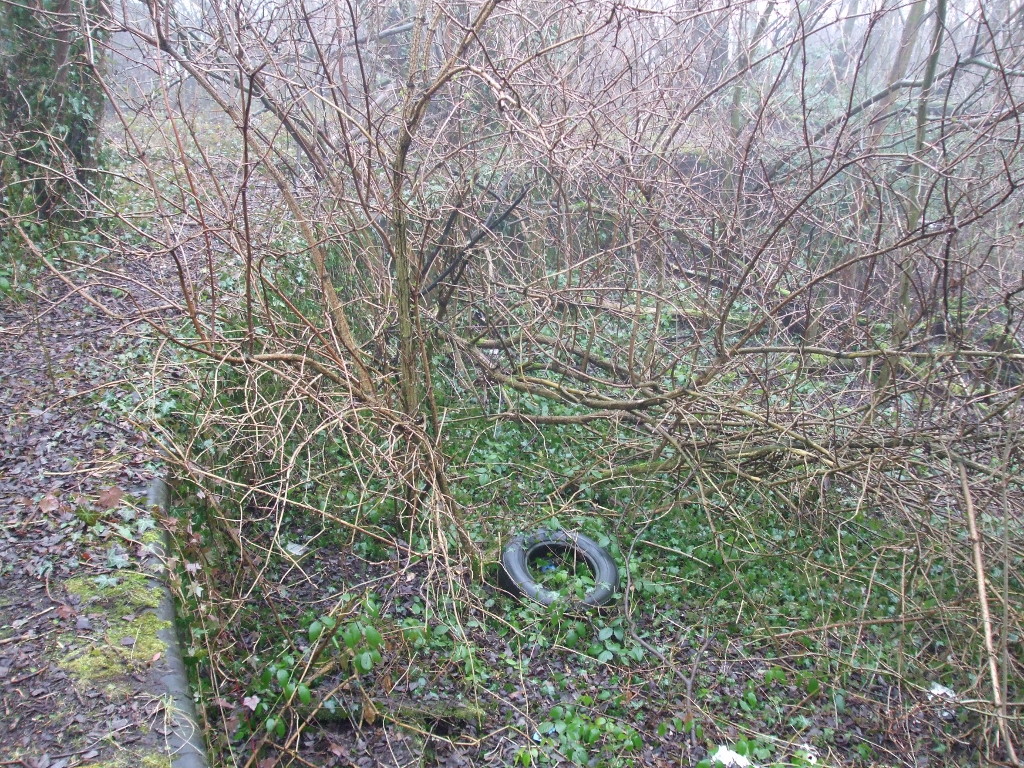
By 1965 the turntable had disappeared from the maps and I so I assumed it had been filled in or built over, especially as I'd never seen any sign of it while walking to and from the station. It isn't always easy to relate old maps to the current terrain, especially given how much the area around Penistone station has changed since the maps were drawn, so imagine my surprise last winter when I almost fell into the turntable pit.

There are actually two footpaths along the railway linking our house with the station. Originally there was just a path right alongside the line, but a couple of years ago a second path was added a little further from the line side to give better pedestrian access to a new housing estate. During the summer this new path is full of interesting wildlife and plants, including a fantastic display of lupins and some interesting caterpillars. During the winter it isn't quite so interesting but it is slightly shorter, so on one icy day I followed the path hoping I'd reach the station without falling over. A combination of the snow highlighting things differently and the lack of undergrowth meant that suddenly there was the turntable pit. Unfortunately I didn't have a camera on me so I had to go back a few days later for some photos.


Given the number of trees growing within and around the pit it's impossible to get a good photo showing its full extent, but from the left hand photo you should be able to get a fairly good idea of its size. I'd hoped to explore the pit a little more during the summer when it wasn't quite so wet and boggy looking, but of course as soon as spring arrived more shrubs grew up making it less accessible. When winter comes around again I'll try and take a better look.